

What they are spraying on our forest and why it matters
This is an opinion piece about the decision to spray a dangerous herbicide, our forest ecology, regenerative land stewardship, and the power of an informed community.
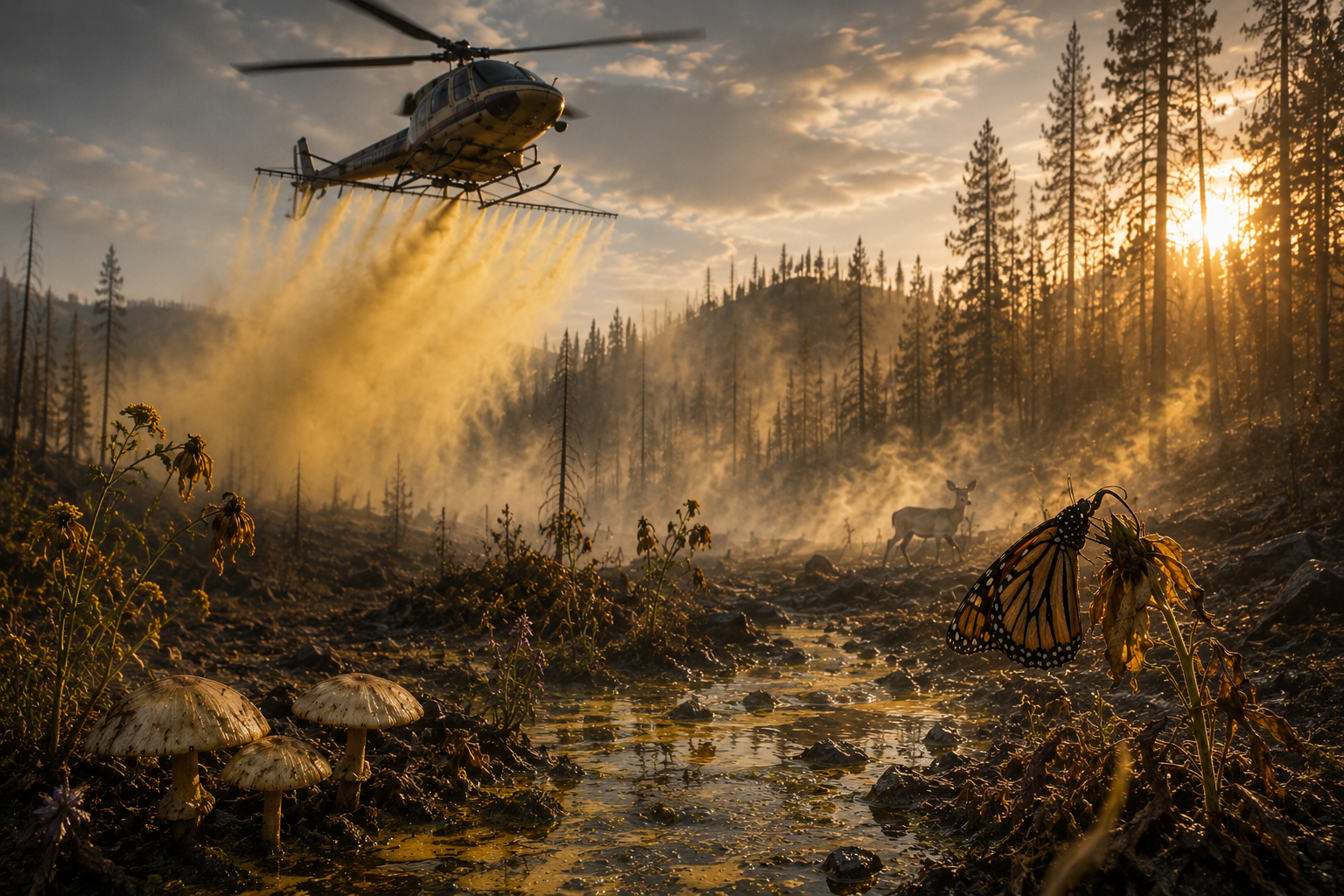
AI generated image of a forest been spray with chemical affecting the watershed, animals and insects, damaging all the ecosystem.
A letter from the land
From Blue Marble Acres, our farm in West Marin, Tomales Bay glitters at the edge of the pasture, the fog rolls off the Pacific each afternoon, cooling the hills and turning the grasses into beautiful greens, the wild plum trees, and a great blue heron patrols the shallows. This land has been farmed organically for years, not because it was easy, but because we believe the soil, the water, the insects, and the animals that share this watershed with us are worth protecting. They are, in every meaningful sense, our partners.
So, when I learned that the California Department of Parks and Recreation is planning to spray herbicides, including glyphosate, the active ingredient in Roundup, on land surrounding Tomales Bay, I felt something crack open. Not surprising, exactly. More like a recognition that the land is not being challenged only by careless actors, but, like in this case, it is endangered in the name of restoration.
This is an opinion piece, using the information I found online from valuable sources, what science says, and what I believe the Marin community can do. I am not a journalist; I am a designer. I don’t live in Marin County. As I am writing this, I am in Playa Negra, Costa Rica on the northern Pacific coast. But I am committed to this beautiful project of Blue Marble Acres, and I have been watching the issue for a long time, and I am willing to spread the information to help a little bit. The research is damning. The regulatory records are troubled. The stakes, for the creek where the children swim, for the animals, insects, and especially for the families who drink water drawn from these hills, are too high for silence.
What are herbicides, and how we got here
Herbicides are chemical compounds designed to kill or inhibit the growth of plants. The modern herbicide industry grew out of post-World War II agricultural intensification, when the same chemical developed for warfare was repurposed to maximize crop yields. The logic was efficiency. Kill weeds, protect monocrops, feed more people faster. The logic was applied decade after decade without reckoning its consecuences, has given us a world in which more than 280 million pounds of glyphosate are sprayed on 285 million acres of U.S. farmland every year.
Glyphosate was patented by Monsanto in the 1970s. It works by inhibiting an enzyme pathway (the shikimate pathway) found in plants, fungi, and bacteria, but according to Monsanto, it is not in animals or humans. This claim became the cornerstone of the product’s regulatory approval and its huge commercial success. Today, glyphosate is the most widely used herbicide in the world. It is also one of the most controversial.
The shikimate pathway, it turns out, is essential to the gut microbiome, the trillions of microorganisms that live in animal and human intestines and play a fundamental role in immune function, metabolism, and neurological health. By disrupting that pathway in soil bacteria and intestinal bacteria, glyphosate may be doing something far more damaging than its original purpose of killing weeds.
By far the largest application of glyphosate is in agriculture, but its use is spreading. According to investigative journalist Nate Halverson’s year-long investigation for Mother Jones, the amount of glyphosate applied annually in California state forests reached 266,000 pounds of pure glyphosate in 2023, nearly five times what it was two decades ago. Forest use has become the herbicide’s fastest-growing market in California.
“Forest uses have become the herbicide’s fastest-growing market in California”
The official justification for forest spraying is wildfire recovery and vegetation management. After a devastating fire, conifers (commercially valuable trees like Douglas fir and pine) have a harder time re-establishing than fast-growing broadleaf shrubs and native plants. Glyphosate kills the competition, giving the conifers a head start. This practice is standard operating procedure for both the U.S. Forest Service and the timber industry, and it has been going on, out of public view, for decades.
What you hardly hear or read about is that our forest is being managed as a tree farm. The biodiversity of the forest, the shrubs, wildflowers, fungi, and leaf litter that support insects, birds, salamanders, and the hydrological cycle itself, is being treated as an obstacle. That is a narrative I have decided to argue with this article, because to me, it is both ecologically wrong and morally untenable.
What the science actually says
Bayer acquired Monsanto in 2018, and they kept saying glyphosate is safe when used as directed, pointing to more than 1,500 studies and 50 years of research. What Bayer will not highlight is the evidence showing that many studies submitted to regulators were of poor scientific quality, and that Monsanto spent decades manipulating the scientific record.
Internal Monsanto documents obtained through litigation and investigative journalism have established that the company ghost-wrote scientific papers, cultivated relationships with regulators, and worked to suppress or discredit independent research. In 2021, researchers at the University of Vienna analyzed 53 glyphosate studies submitted to regulators by pesticide companies and found that most did not comply with modern international standards for scientific rigor, and only two of the eleven studies Monsanto submitted to EU regulators were deemed reliable.
Below, I am sharing some insights into what the independent science shows:
Cancer
In 2015, the World Health Organization and its Agency for Research on Cancer (IARC) classified glyphosate as “probably carcinogenic to humans”, based on limited evidence in humans and sufficient evidence in animals. An ongoing long-term animal study from the Ramazzini Institute, part of the most comprehensive toxicological study ever conducted on glyphosate, found that low doses caused multiple types of cancer in rats, providing what the researchers described as robust evidence supporting IARC’s conclusions.
A UC Berkeley review found strong evidence for five to ten key characteristics of carcinogens, with particularly strong findings around genotoxicity and endocrine disruption. Multiple meta-analyses have confirmed a statistically significant association between glyphosate exposure and non-Hodgkin lymphoma. Bayer has paid more than $12 billion in legal settlements to people who say Roundup gave them cancer, while continuing to maintain the product is safe.
Endocrine disruption
Perhaps more alarming than cancer data is the evidence that glyphosate functions as an endocrine-disrupting chemical, interfering with hormonal systems at extremely low doses, which industry and regulators have historically considered safe because they assumed that lower exposure meant lower harm. This assumption is wrong.
A comprehensive 2020 review concluded that glyphosate meets at least eight of ten key characteristics of endocrine-disrupting chemicals. Researchers have documented disruption of thyroid function, female reproductive hormones, and metabolic regulation. A 2025 study found that glyphosate disrupts female hormones and damages the ovaries and uterus in ways that impair fertility and is also associated with polycystic syndrome and endometriosis. Another 2025 study published in the Proceedings of the National Academy of Sciences found that the introduction of glyphosate-tolerant GMO crops significantly reduced average birthweight and gestational length in exposed rural populations.
As recently as 2025, a study found that even extremely small amounts of glyphosate can harm the gut, disrupt metabolism, and alter behavior in mice, and that these harms persist across generations. This transgenerational damage is a hallmark of endocrine-disrupting chemicals, because their reach extends not just to those exposed, but to their children, grandchildren, and great-grandchildren.
Liver Disease
A 2025 review of more than 40 scientific studies found that glyphosate may significantly raise the risk of metabolic dysfunction-associated steatotic liver disease, an increasingly common chronic liver condition, even at low exposure levels. A 2023 UC Berkeley study documented a strong association between childhood glyphosate exposure and markers of liver damage predictive of non-alcoholic fatty liver disease and metabolic syndrome in young adulthood. Liver cancer, diabetes, and cardiovascular disease can follow.
Contamination is almost everywhere
Between 2013 and 2014, glyphosate was detectable in the urine of 81.2% of U.S. study participants. A 2022 CDC report found glyphosate in more than 80% of urine samples drawn from children and adults across the country. Scientists described this finding as “disturbing” and “concerning”. A 2020 USGS study found glyphosate in more than 70% of American streams tested.
At this point, I am not arguing about the hypothetical risk. The chemical is already in human bodies, in children, and in the water. Every additional application, whether on farmland, roadsides, or in the forest, adds to a burden that is already too high.
California’s regulatory landscape: Progress and Opportunities
California has stronger pesticide regulations than most U.S. states, and this matters. The state requires mandatory commercial pesticide use reporting, which is precisely how Halverson was able to document the scale of forest glyphosate use in his investigation. Without that requirement, we would be operating in the dark, as most of the country still does.
California’s Office of Environmental Health Hazard Assessment (OEHHA) added glyphosate to the state’s Proposition 65 list of chemicals known to cause cancer in 2017, a decision challenged by Monsanto in court. Proposition 65 requires businesses to provide warnings when they knowingly expose Californians to listed chemicals. For a time, Roundup products sold in California carried cancer warnings.
The Ninth Circuit Court of Appeals, in a 2022 ruling, rejected the U.S. EPA’s determination that glyphosate posed no unreasonable risk to humans or the environment, finding that the agency had failed to follow proper scientific protocols. In September 2022, the EPA withdrew its interim decision on glyphosate, effectively acknowledging that its own assessment was legally and scientifically untenable.
And yet, despite all of this, the California Forest Service is moving forward with a plan to spray glyphosate on 10,000 acres of public land in Lassen. Despite all of this, the California Parks Department is planning to use glyphosate as part of a “forest restoration” project affecting sensitive land around Tomales Bay.
There is an opportunity between what the science shows, what the courts have found, and what government agencies are actually doing.
California’s regulatory framework is better than most, but it is not good enough to protect the people and the land if the agencies charged with land stewardship are not bound by it in practice. What’s needed is not weaker enforcement of existing rules, but stronger restrictions on public land applications, mandatory public notification before any spraying near waterways or homes, independent water quality testing funded by the agencies conducting the spraying, and genuine investment in non-chemical alternatives.
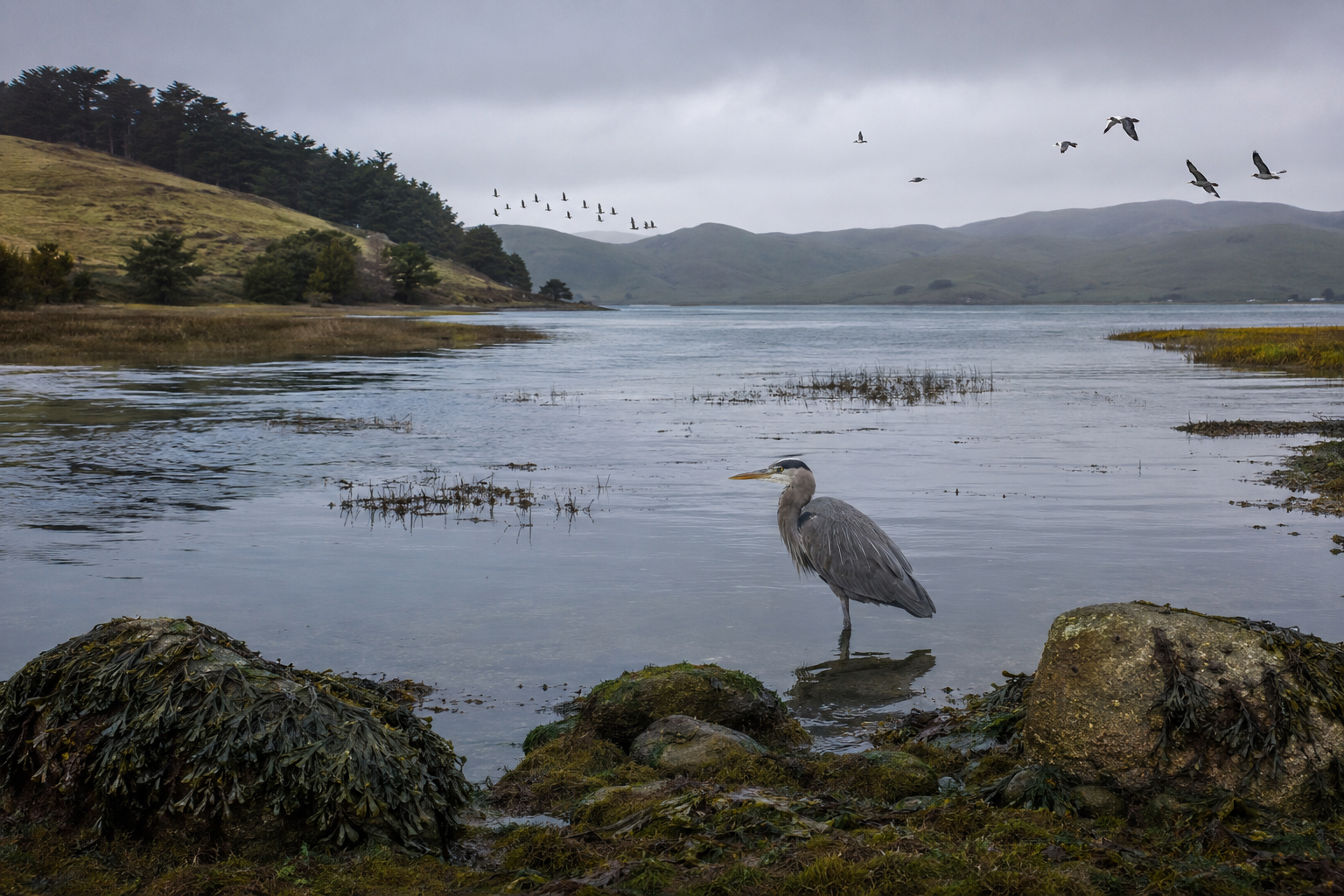
AI generated image of a healthy creek in the West Marin area.
The land doesn’t lie: Ecological impacts in West Marin
Tomales Bay is one of the most ecologically significant places on the Pacific Coast. It hosts more than 490 species of migratory birds. It is home to endangered and threatened species, including the California Freshwater Shrimp, Coho Salmon, California Red-Legged Frog, California Tiger Salamander, and the Northern Spotted Owl. The creeks that drain the surrounding hills carry water, and whatever is dissolved in that water, directly into the Bay.
The proposed treatment areas in the Tomales Bay State Park Forest Health and Wildfire Resilience Project are, in several cases, immediately adjacent to these waterways. Some are near homes. The plan acknowledges the use of multiple herbicides, with glyphosate listed among them. The scale, six acres of herbicide treatment, is small compared to Lassen. But in a watershed this ecologically sensitive, with this density of threatened species, the consequences of even a small application can cascade widely.
Birds
Glyphosate harms birds primarily by destroying the insect population they depend on. In treated areas, the crash in the invertebrate population can leave nestlings without sufficient food during the critical weeks after hatching, starving an entire generation. Direct exposure causes severe eye and respiratory irritation and can be lethal. For the Northern Spotted Owl, glyphosate destroys nesting materials and reduces populations of the small mammals it hunts.
Salmon and amphibians
Coho Salmon have an extraordinarily sensitive sense of smell, which they use for navigation and predator avoidance. Glyphosate exposure impairs this olfactory capacity, leaving fish disoriented and vulnerable. It also reduces egg viability and spawning success. For the California Red-Legged Frog and California Tiger Salamander, the surfactants in herbicide formulations penetrate thin skin membranes, effectively suffocating tadpoles. The removal of understory vegetation eliminates the leaf litter and soil moisture that salamanders require to survive. Glyphosate can kill amphibians directly and immediately.
Drinking water
The creeks flowing from the hills around Tomales Bay are the same creeks where local children wade in summer. They flow toward the Bay, and some feed into water sources that supply local homes. The recurrent question is one: Will the California Parks Department pay to test local water sources before and after spraying? Will they test the swimming holes? Will they post warnings? Will they take responsibility for what flows downstream?
A 2020 USGS (U.S. Geological Survey) study found glyphosate in more than 70% of American streams. Given that context, the burden of proof should not fall on the community to show that spraying near waterways is dangerous. The burden should fall on the agencies to demonstrate that it is safe, and by the existing science, they cannot.
“Regenerative” herbicide use is a lie
One of the hardest things for me while I am writing this piece is knowing the effort our team at Blue Marble Acres has been putting in for almost 5 years now, using organic practices, restoring the land, giving love to the land, and, in return, receiving a lot from nature. And when I read about the framing of these bad actors, who plan these projects, disregarding the environment, Many of them genuinely believe they are doing the right thing. The language they use- “forest health”, “wildfire resilience”, “native plant restoration”- is the language of environmental stewardship.
But here is the contradiction I can’t resolve: you can’t regenerate a forest ecosystem by saturating it with a chemical that kills bacteria, disrupts fungi, and eliminates the botanical diversity that supports every other form of life in that system.
“Regenerative land stewardship is about rebuilding relationships between soil, microbes, and plant roots, between plants and insects, between insects and birds, between the forest and the water cycles. Glyphosate does not rebuild relationships. ”
Halverson’s investigation makes clear what this approach actually produces: a tree farm, not a forest. When glyphosate is used after wildfire to clear the field for commercially valuable conifers, it eliminates the native shrubs, flowering plants, and other trees that would, left to their own devices, create a mosaic of habitat far more resilient to future fires and far more ecologically rich than a monoculture plantation. The executives and bureaucrats managing our national forests as industrial timber operations are not wrong that conifers grow faster with the competition removed. They are wrong to call this restoration.
From Blue Marble Acres, the real meaning of regenerative agriculture is observable every day. It means building soil biology, not destroying the land. It means tolerating weeds because weeds feed insects, and insects feed birds, and birds and their droppings seed new plants. It means accepting that the land is not a production system to be optimized but a living community to be tended with humility.
West Marin: A history of land and stewardship
West Marin has a peculiar and precious place in the California story. The Point Reyes National Seashore, established in 1962, protects one of the most biologically diverse stretches of California coastline. The agricultural preserve created by Marin County in 1972 was among the first of its kind in the nation, a deliberate decision to protect working farmland from suburban sprawl. These decisions were almost unthinkable.
The farms of West Marin, dairy ranches, vegetable operations, and oyster farms have operated within that protected landscape for generations. Many have shifted toward organic and regenerative practices not because it was mandated but because the farmers here tend to understand, intuitively and practically, that their livelihood depends on the health of the land and water they steward.
The Tomales Bay watershed has also been the territory of the Coast Miwok people, whose land stewardship practices, including the use of controlled fire to manage vegetation, created the landscape.
West Marin has a long tradition of environmental activism. The campaigns to establish the national seashore, to protect the agricultural land from development, and to fight for clean water in Tomales Bay. These were all won by communities that organized, showed up, and refused to defer to institutional authority when that authority was wrong. That history is a resource, and it’s also a responsibility.
The proposal to spray herbicides in the Tomales Bay watershed is not the first time the community has had to confront a threat to this land from an unexpected quarter. It will not be the last. But it is a test of whether the values from the community can be brought to bear in time to make a difference.
A call to action for our farm community
Activism is not the opposite of optimism. It is an honest expression of positivity. The people who established the Point Reyes National Seashore, the people who established the Marin Agricultural Land Trust, and the people who kept the oyster farms alive in Tomales Bay against regulatory pressure. All these people are not pessimists. They were people who loved something enough to challenge the system.
We are being asked to love something enough to challenge the system again. Here are some ideas our team believes we can do.
Demand transparency and accountability from public agencies. Before any herbicide application on public land near waterways or areas used by children, we should demand independent baseline water quality testing and mandatory public notification at least 60 days in advance. Contact the agencies directly, by phone and in writing, and make your concerns part of the public record.
Organize the farm community as a scientific and political force. Organic and regenerative farmers have something that the government often lacks: direct, intimate knowledge of how land responds to different management practices. We have observed over the years what happens when you stop spraying and start nurturing the soil. That knowledge is valuable and persuasive. Talk to people at farmers' markets, community dinners, and the store. Invite and build a coalition broadly: oyster farmers care about water quality, ranchers care about watershed health, parents care about what their children are exposed to.
Practice genuine regenerative alternatives. Document what you observe on your farm: the return of insect life, the soil biology improvements, the resilience of pastures during drought. Share photographs, soil test, water quality data. Make science visible and local. Show agencies what is possible without chemical control.
Support investigative journalism and organizations. Nate Halverson’s investigation for Mother Jones required a year of work and access to more than five million records. Kristin Lawless has been writing about glyphosate for fifteen years. U.S. Right To Know has compiled and published the most comprehensive database of independent glyphosate research available. This work depends on public support. Subscribe, donate, share, and amplify.
Engage in the political process. Call your state assembly member and state senator. Write to the governor’s office. Attend public comment hearings for forest management and park projects in your region. Demand that California’s mandatory pesticide reporting requirements be extended to all public land and that results be posted publicly. Push for state legislation requiring non-chemical alternatives to be considered and documented before herbicide application on public land. The California regulatory framework is better, but still not good enough. There is an opportunity for political action.
Protect your own land, water, and children. Remove shoes before entering your home, and filter your drinking water. If you have children, monitor any public announcements of nearby spraying activities. Advocate for your local water utility to test for glyphosate. Support your local food systems and organic and regenerative farms. When you eat from this land, you are part of it. Act accordingly.
Honor indigenous knowledge and support the land. The Coast Miwok people managed this landscape for thousands of years using practices that maintained the biodiversity and resilience that we are now trying to recover. Engaging with Indigenous practitioners and organizations in Marin is not only an act of justice, it is a practical strategy for land stewardship grounded in a depth of tribal organizations working on land and water stewardship in this region.
“The public must decide whether it wishes to continue on the present road, and it can only do so when in full possession of the facts.”
The right to know
Rachel Carson published Silent Spring in 1962. She was attacked and dismissed by the chemical industry and by government scientists who had staked their careers on the very practices she was challenging. She died of cancer two years later, in 1964. The book she wrote changed the world.
We are, again, in possession of the facts. More facts than Carson had. Better science. More documentation of what these chemicals do to living systems. What we have not yet had is the collective will to act on what we know.
From Blue Marble Acres, looking out at the Bay on a clear evening, with herons in the shallows, and the hills still green from the spring rains. It is hard to be purely pessimistic. The land is resilient. The community from West Marin is remarkable. The science is on our side. The courts have begun to acknowledge what the studies have long shown.
The question is whether we move quickly enough, and loudly enough, to protect what we love before it is further damaged. I believe this community can. The land has survived so much. We are a generation that kept protecting when the land needed us most.
Sources and further reading
The following sources I used to write the foundation of this article:
Kristin Lawless “California is spraying our forest with glyphosate” The Unsettled Substack, May 2026
Stacy Malkan, U.S. Right To Know “Glyphosate: Cancer, Liver Disease, Endocrine Disruption and other health concerns”, Apr 2026
Nate Halverson “We are bombarding America’s forests with Roundup” Mother Jones, May 2026
Ramazzini Institute. Ongoing global glyphosate study “Long-term animal study on glyphosate carcinogenicity” Environmental Health, Jun 2025
UC Berkeley School of Public Health. “Childhood exposure to common herbicide may increase risk of disease in young adulthood” 2023
PNAS Study “Significant adverse perinatal health effects due to increased glyphosate exposure” University of Oregon, Jan 2025
Tomales Bay State Park Forest Health and Wildfire Resilience Project
USGS “Herbicide Glyphosate prevalent in U.S. streams and rivers” 2020
Ninth Circuit Court of Appeals. Ruling on the EPA Glyphosate Decision. Jun 2022
IARC / WHO “IARC monographs volume 112: Evaluation of Five Organophosphate Insecticides and Herbicides” Mar 2015
All scientific claims are sourced, and this article represents the opinion of the author and does not constitute legal or medical advice.
