Turning pits into peaks: Nurturing the next generation of leaders
There are people you meet who carry their story in everything they do, in the way they speak, in the fire behind their eyes, in the quiet certainty of someone who has already survived the worst. In my conversation with Coach Jerome Gumbs, I witnessed one of those people. He is the Founder and CEO of Empower Me Academy (EMA), a former professional athlete, mentor to over 5,000 young people across the San Francisco Bay Area, and a longtime friend of George Gund, Blue Marble Acres Founder. This article is based on an honest and inspiring video call I had with him.
What followed was more than an interview; it was a masterclass in resilience, purpose, and the kind of leadership that only comes from having truly lived.

Portrait of Coach Jerome Gumbs (Image taken from www.empowermeacademy.net)
Growing up in a challenging zone
When most people think of the Caribbean, they picture beautiful water and endless sunshine, but Coach Gumbs grew up in the U.S. Virgin Islands, and his version is somewhere very different.
“When I think of the Caribbean and where I grew up, I think of trauma. I think of violence and anxiety. I think of death and murder. I grew up in a place where education was not really important. I grew up in a culture where fighting was more important.”
In 2018, the USVI was documented as the murder capital of the Caribbean per capita. A staggering reality for a set of islands with fewer than 200,000 residents across three islands. For a young Jerome, navigating that world required a kind of emotional intelligence that most children are never asked to develop.
“I had to learn how to stay away from certain neighborhoods. I had to learn how to have a certain face so people didn’t pick on me. But at home, I had a beautiful mom.”
His mother, Ann Gumbs, worked at the Marriott for 47 years cleaning rooms, retiring only because a hurricane destroyed the building. His father, Wilbert, built houses from the time he was in middle school, never having finished his own education. Together, they gave Jerome something no neighborhood could take away, a foundation of love, faith, and relentless work ethic.
But the moment that changed everything came at age 13. Racing bicycles with friends, Jerome suffered a severe head injury that sent him to a hospital in Puerto Rico. His skull was pressing on his brain, causing seizures. Surgery was prepared, then postponed. Then, a miracle. The pressure released on its own.
“I remember saying, God, please don’t let me die. I promise I will change. So the day they were supposed to have surgery, they did not have it because my skull had somehow miraculously stopped touching my brain. That is when I committed. It was not a flip of a switch; I still had a lot of work, but that is when I started thinking, ok, I’ve been given a second chance at life.”
Coach Gumbs still has the dent in his skull today. He calls it his reminder.
From that moment, basketball became his path. His Junior National Coach Cyril Benjamin (CB) saw something in Jerome that went beyond athletic talent. CB became a second father, a mentor, and gave him the blueprint for everything Coach Gumbs would one day build himself. Under CB’s guidance, Jerome was named the U.S. Virgin Islands’ Best High School Player in 1999. He went on to earn a scholarship to the University of San Francisco, where he became team captain, earned WCC Player of the Week honors, and scored 31 points against a Texas Tech team coached by the legendary Bobby Knight. After college, Jerome spent eight years playing professional basketball overseas, winning a European Championship.
But the accolades were never the point. “If I did not find basketball, I would not be alive.”
The powerful reason behind EMA
Empower Me Academy was not born only from ambition but love, specifically, a father’s love for a son he did not meet until the boy was nine years old.
“I built it for my son. When I thought to myself, if I go coach in college, I would not be able to make sure my son does not go through what I went through. And I felt that I was not prepared for everything I experienced. My son and a lot of children won’t be prepared either.”
Coach Gumbs had seen what coaching culture could do to a person, both coaches who lifted him and the ones who tore him down. He quit basketball during his senior year of college because of a coach who undermined his confidence. He knew what it felt to be in an environment that either built you up or broke you. And when he looked around San Francisco, he did not see anything using sports as a true vehicle for human development.
“I saw everything here as sports being about winning and losing and just getting a lot of money. So I started building EMA.”
It began modestly, training children of lawyers and venture capitalists in weekend pickup games, first for free, then for a small fee. But the philosophy was always the same: basketball is just the magnet.
“It is the excuse to attract children and to teach them to be a better version of themselves. Nelson Mandela said it; sports speaks to children in a way they understand.”
“Basketball is just a magnet. It’s the excuse to attract children and teach them to be a better version of themselves.”
Today, EMA combines elite basketball training with social-emotional learning, digital citizenship, personal branding, and purpose-driven mentorship. The program’s philosophy is rooted in a simple but powerful elevator pitch: Coach Gumbs wants to create the next Steph Curry, who becomes the next Barack Obama.
“My mom used to say, make sure who you are off the court outshines who you are on the court. Because I was hearing that, make sure who you are in the classroom, who you are in the community, is way more important than who you are as a basketball player. That resonated with me.”
EMA pushes back against a $40 billion youth sports industry that, in Coach Gumbs’ view, profits enormously while giving very little back to the children at its center.
“More than 30 million children play youth sports across the world, and they are the least benefited of all this money. That’s a problem. It’s a huge problem that no one really talks about.”
His response was to build something different. A development program, not a tournament circuit. A place where the mantras stick for life. Former students who are now young adults still carry EMA phrases like “everything we do, we do with excellence” and “you are not working hard unless you are out of your comfort zone.” Some have come back to work for the academy itself.
“I think that’s the sign of a really strong culture.”
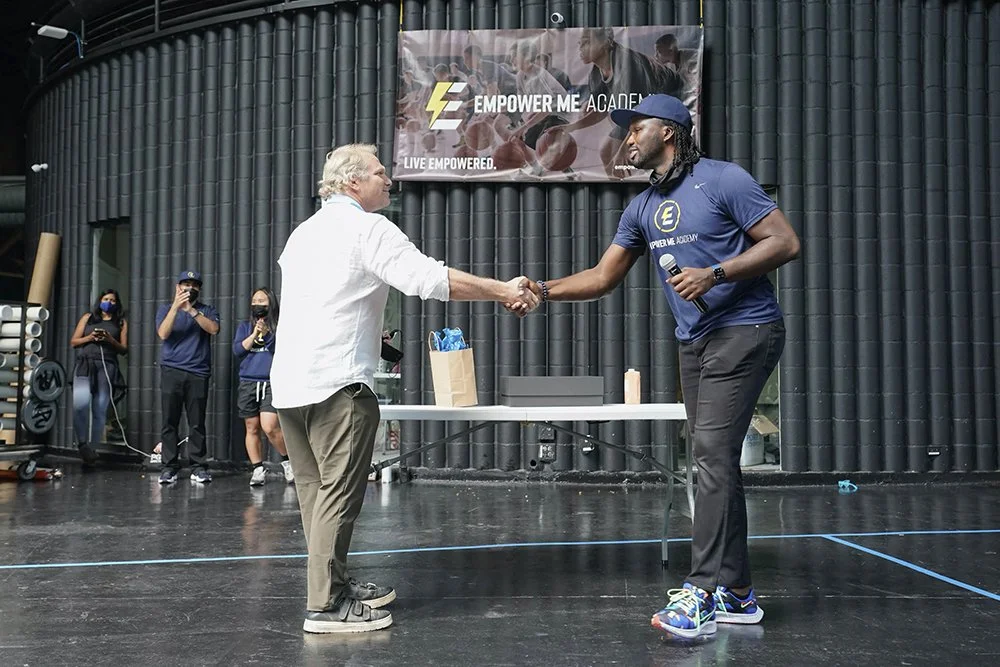
George Gund (Founder of Blue Marble Acres) and Coach Gumbs at an event from Empower Me Academy (Image taken from www.empowermeacademy.net)
When the court meets the farm
Years ago, George Gund described his vision for Blue Marble Acres to Coach Gumbs, and he had a vivid reaction. “I started calling it the Disneyland for farmers. When he was pitching what he wanted to do, I was like, man, this is going to be like Disney World.”
That vision became reality when a group of EMA students visited Blue Marble Acres, walking through regenerative agricultural fields with Edgar Cox, the agricultural manager, collecting fresh eggs, visiting the grazing sheep, and getting their hands close to the crops, under the guidance of Adrian Fontaine, the land foreman.
For many of these students, it was a first.
“A lot of children, especially from underserved communities, don’t have that access. It is so therapeutic. There is a reason people walk through Golden Gate Park, walk through the woods. Mother Nature is the best therapist.”
Coach Gumbs describes something he observed time and again when students encounter nature: a transformation that students themselves can’t quite explain.
“The children go from I don’t want to go there cause I don’t want to get my shoes dirty, to when they leave you can hear them say ' Wow, that felt good!. They can’t explain it. But the experience of leaving the city, the hustle, the cars honking, and just going out, feeling the sun, picking eggs, respecting plants enough to pick fruits with care… I think farming is one of the most empowering experiences.”
The metaphor between farming and EMA’s mission runs deep.
“I tell children all the time, you can’t put $20 in the bank and then show up to the ATM and try to pull out $100. That’s not how it works. And it’s the same thing with planting, nurturing, and then harvesting. I tell people, children are like plants. When they are in the right environment, they survive.”
For Coach Gumbs, both Blue Marble Acres and Empower Me Academy are fundamentally about environment. They are both places that ask young people to slow down, pay attention, and understand that what you put in is what you get out, whether that is in the soil, on the court, or in life.
“EMA is an environment where people come in and feel better about themselves, and that is what I know George and his team will do for our community, because our organization functions how the leader functions. I have always felt seen, valued, and respected by George. And I know that he and the BMA team will do the same.”
The partnership between EMA and BMA is still growing, but its roots are already clear: two organizations, one using sports and one using the land, both working to teach the next generation that patience, care, and commitment to something greater than yourself are the foundations of a meaningful life.
The legacy is a mission that endures
The most quietly devastating part of Coach Gumb’s story did not happen in a gym or on a basketball court; it happened at a hospital bedside.
Two years ago, his mother Ann, the woman he describes as his hero, his north star, the reason he became who he is, passed away from cancer. His sister, his best friend, followed two months later. He dropped everything to be present for those final days, and EMA nearly fell apart in the process.
“When the company almost died, I remember my mom saying, ' How is the company doing? ' and I responded, ' Mom, you know it’s not doing well, but I’m here. And she said, you got to go back, because to my mom, the thing that she loved more than anything was EMA. Empower Me Academy made her so proud, because her son, who could have been a gangster, turned his life around to help children.”
Before she died, his mother grabbed his hand and told him not to worry. She said God would protect EMA because he had built it for the right reasons.
“And I started bawling, and I looked at her, and I said, Mom, only you would be dying and worried about me.”
When he returned after burying her, he came back to the root of why he started. He came back to the mission.
This fall, the University of San Francisco will honor Coach Gumbs and the academy for living the mission, an acknowledgment he says means more to him than anything he ever achieved as a player.
Before finishing our conversation, I asked what the nine-year-old Jerome would think if he could see Empower Me Academy today; Coach Gumbs had to pause.
“I don’t think I’ve gotten this emotional on a call in a while. That boy would be proud. Because he knew what I would have had to experience and survive, and what relationships I would have had to nurture and develop, to be where I am today. I am a very lucky guy.”
“I was given a second chance to live. And I don’t take that lightly. So every day I wake up, it’s another day to be grateful.”
The future: the language of purpose
Coach Gumbs does not speak about Empower Me Academy plans with the language of ambition. He recognizes it is all about having purpose. As something that was always meant to exist, and that will continue to grow because the need is real and the mission is true.
He wants to bring EMA students to Blue Marble Acres regularly, making farm visits a consistent thread in the program. A living classroom where the lessons of patience, stewardship, and what-you-plant-is-what-you-harvest become as familiar as the basketball court. He wants his community to meet George and the BMA team because he believes that the culture of an organization flows from its leadership, and he trusts what he has witnessed in that leadership firsthand.
He talks about gathering data to show the world their program’s impact, what happens to children who come through programs like this. The captains, the young professionals, and the ones who came back to work at EMA itself.
And he talks about the children who are still coming. The ones who arrive not feeling good about themselves and leave with something they didn’t have before: confidence, tools, a voice.
“When you hear Empower Me Academy, it is a direct command. Empower me. Make me feel good. Make me better. Make me more confident. Give me better self-esteem. It is a demand. And to correlate that demand, we are very demanding. We demand a lot from our students. Because children can accomplish so much of you give them the structure, the safe haven, and raise the bar.
He closes with the quote he has carried since the beginning, the one that sits at the heart of everything Empower Me Academy stands for:
“A leader should not be measured by the number of followers they have, but by the number of leaders they nurture.”
Blue Marble Acres is proud to partner with Empower Me Academy in nurturing environments where the next generation of leaders can grow. To learn more about EMA, please visit their website: www.empowermeacademy.net. To learn more about what we are building at Blue Marble Acres, make sure to follow us on social media @bluemarbleacres_marin and explore more in our blog.