

The man behind the infrastructure: Meet Rodolfo
In Part 1: Protect, Adrian told the story of how Blue Marble Acres learned to catch and keep its water. Storing water is only half of the work, because it still has to reach the farm stand, the greenhouses, the orchard, and every structure on the ranch. That is Part 2: Move, and it is Rodolfo’s world. As the leader of our construction and infrastructure crew, he works with springs, gravity, solar pumps, and tanks to carry water across 772 acres of hillside, and he is just as busy dealing with what happens when too much of it arrives at once.
If you have ever driven along Point Reyes Petaluma Road and noticed a large structure that used to be a loafing barn, taken Hicks Valley Road to our farm stand, or passed the small orchard along Novato Boulevard, then you have experienced Rodolfo’s work, even if you never knew his name.
Rodolfo leads the construction and infrastructure crew at Blue Marble Acres. He is the person behind the springs that feed our structures, the roads that wind across the property, and nearly every renovation project on the ranch. I sat down with him to talk about how he found his way here, the systems he has built, the team he leads, and what is still to come.
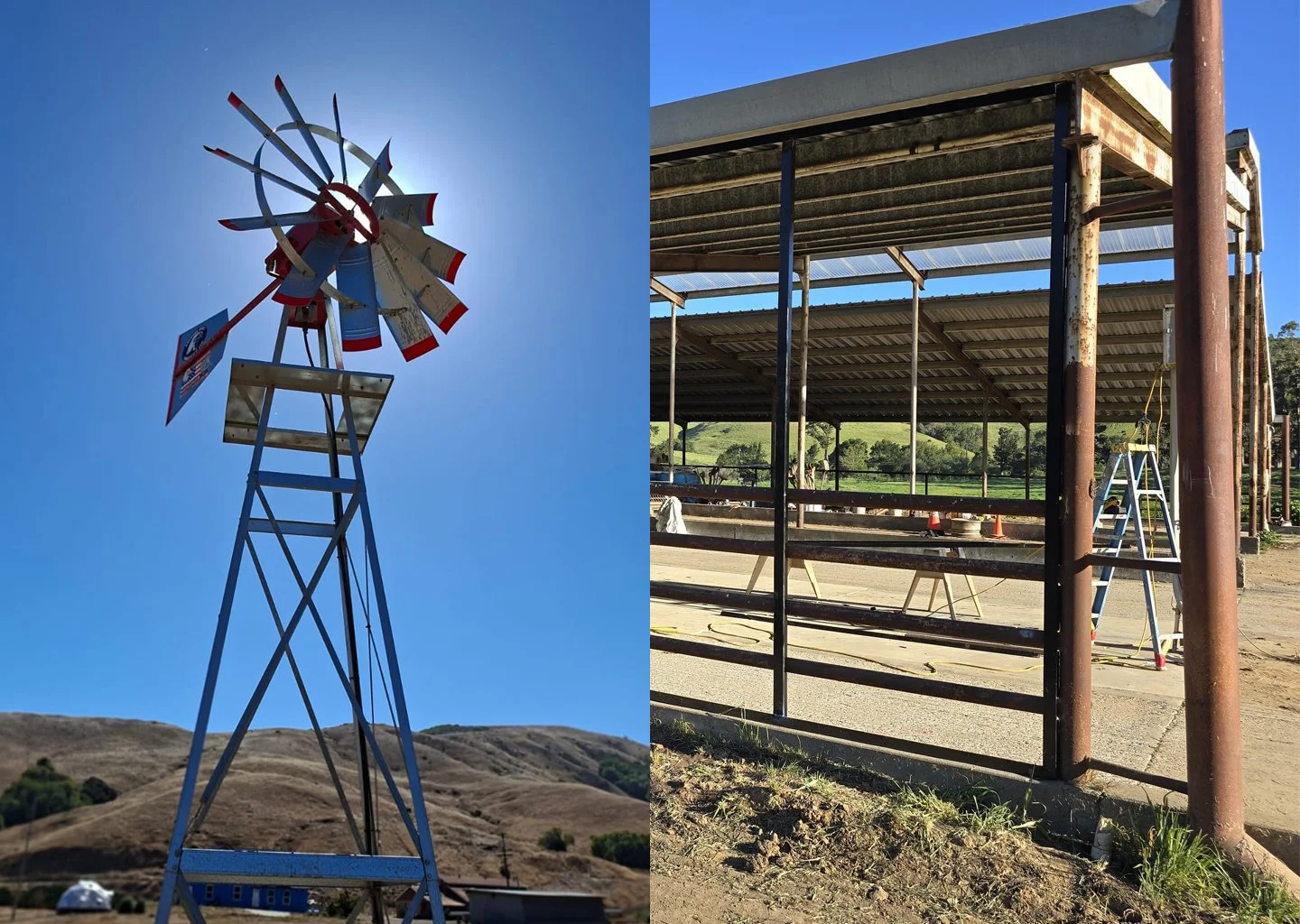
LEFT: windmill near the loafing barn. RIGHT: The initial works to renovate the loafing barn and turn it into a greenhouses and outdoor space to host the community.
From satellite cable to springs and soil
Rodolfo spent 16 years working for a communications company, starting as a technician running cable so people could get satellite TV. On his days off, he worked alongside his father, who did landscaping and irrigation work, planting flowerbeds, laying brick walls, building the kind of hands-on knowledge that doesn’t come from a classroom.
Eventually, the job stopped making sense. He was training people for positions that paid more than his own, and the company was only offering him a path forward if he moved to another office, possibly another state. With young kids at home, that was not a trade he was willing to make. He gave notice, timing his last day to land exactly 16 years after his first.
Around the same time, a family connection led to housecleaning and maintenance work, which turned into building garden beds and irrigation systems. That work eventually connected him to a small ranch outside of Petaluma and an offer to help full-time. That ranch was what would become Blue Marble Acres. Five years later, he is still here, now leading a crew.
His first project on the property was diverting water above what is now the farm stand parking lot, digging nearly a mile of drain, and laying perforated pipe to carry water off the hillside and into the creek, protecting the acres below from flooding. It was also where he first learned to run the farm’s heavy equipment.
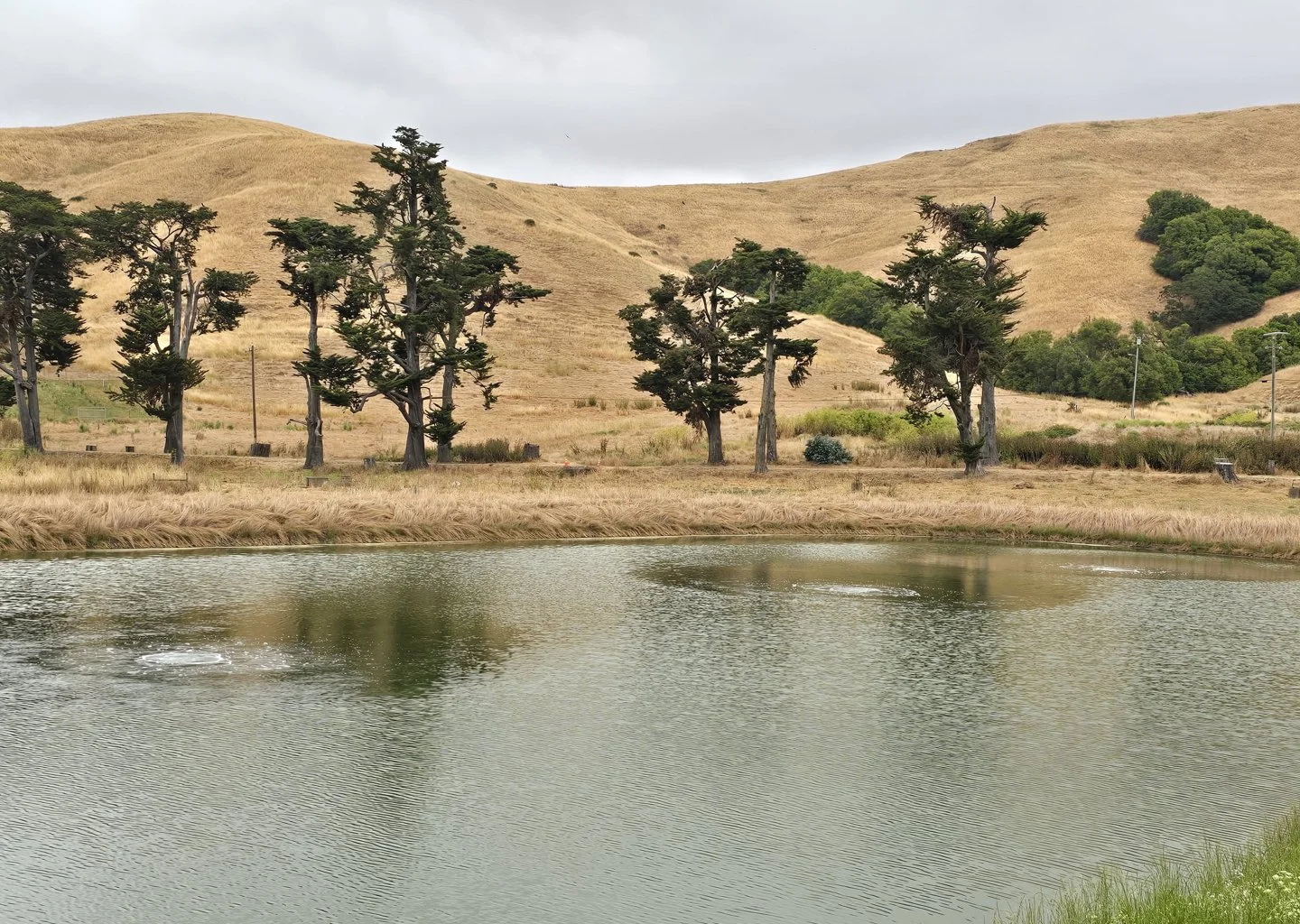
The lake by the loafing barn
Water: gravity, springs, and a million-gallon idea
Where Adrian’s story is about capturing water, Rodolfo’s is about getting it where it needs to go.
Water infrastructure has been one of Rodolfo’s steadiest responsibilities. The structures on the property are currently supplied by a single natural spring, water that rises naturally into a buried pipe and flows, entirely by gravity, into a holding cistern. From there, it is distributed to the structures. It is the same spring that sits at the heart of Matt’s story in Part 3.
The spring is only one of several on the property. Rodolfo estimates there are more of which to be connected to the same water system and are not currently in use.
“I’ve talked to Elfago, and he has taken me to other places; there are more springs we are not using on this ranch,” Rodolfo said. “It is a project I would like to tackle, with time, collecting as much natural water on this land as we can.”
Getting water to the orchard required a different solution. A solar-powered pump lifts water to a series of three 5,000-gallon tanks at the top of a hill, which then feed the orchard acre near the south limit of the property entirely by gravity; no pump is required to go down. The catch: heat and sunlight cause the tubes to expand during the day, effectively sealing them shut, so most of the flow actually happens at night as temperatures drop. It is a detail that Rodolfo and his team, Juan and Carmelo, check daily.
Looking ahead, there is a plan in motion to build a large lined pond near the loafing barn capable of holding somewhere between 800,000 and a million gallons, fed from the existing tank system. The goal is to support the farm’s planted acreage as it grows from 7 to potentially 21 usable acres. It would be the next chapter of the storage story Adrian tells in part 1.
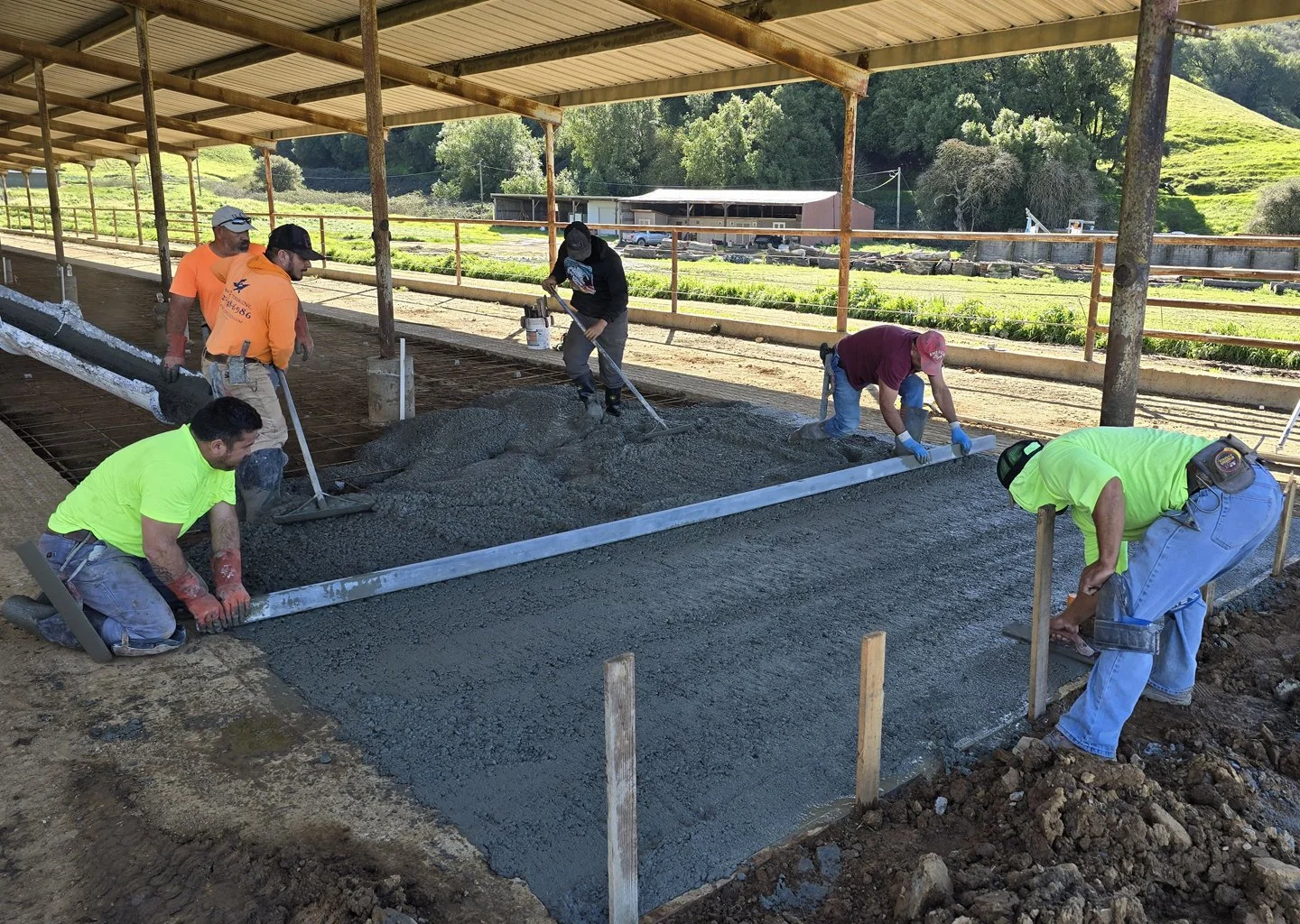
Rodolfo’s crew working on the infrastructure that will become the greenhouses.
Renovation and roads: living with erosion
This year’s biggest infrastructure project has been the greenhouse: six separate rooms, each designed to hold its own microclimate, with electricity and water already run and a climate control system currently being designed. Alongside that, the crew has been replacing the siding and windows on the main structure.
Moving water also means managing it when it moves on its own. Roads and erosion control are an ongoing challenge. Years of cattle grazing wherever they pleased stripped much of the vegetation that would otherwise hold the soil in place, and heavy rain regularly washes sand and gravel off the road surfaces. Rodolfo has been experimenting with agave roots, planted along the hillside above one especially erosion-prone stretch of road, betting that their fast-growing, low-water root systems can help stabilize the slope over time. It is also a water-quality story: as Matt explains in Part 3, every road graded and every slope stabilized here ripples downstream toward Walker Creek and Tomales Bay.
Not every project goes smoothly. Rodolfo pointed to the dome structure as one of the hardest: built from wood with ten to twelve internal sides, it needed to be perfectly symmetrical, and then it rained. The wood expanded, the plastic covering no longer fit, and every bolt had to be tightened once the wood dried back out.
“One thing about this property is that every day there is a new project; you come in with a plan to do something today, and two or three hours later, everything changes.”
Despite the constant shifting priorities, he is philosophical about it: “If you are someone who doesn’t tolerate things changing, this job is not for you.”
When asked which project he is most proud of, Rodolfo didn’t point to the biggest one; he pointed to the storage structure he built, including the room that now houses the mushroom lab and another that has controlled temperature and humidity.
“It is one of the projects I’ve seen from start to finish, one I can really be proud of, because it was started and it was finished,” he said. “A lot of projects stay started; you don’t always get that feeling of having completed something.”
The crew
Rodolfo’s team includes Juan, Manuel, Carmelo, José, and Alfonso, along with his brother, who helps a few days a week around his other job. Juan effectively runs things when Rodolfo is not around, trusted, responsible, and quick to check in before making a call rather than acting alone. Manuel and Carmelo focus on infrastructure work like the greenhouses and storage structures, while José and Alfonso handle the daily maintenance that never really stops: mowing, brush clearance for fire prevention, road upkeep, and trimming fallen branches.
Rodolfo learned most of what he knows by watching his father, and he has built his crew’s culture the same way: hands-on and willing to bring in outside specialists (concrete crews, welders, roofers) rather than force a job that is not in the team’s wheelhouse yet. He is also willing to invest in the right tools that make good work possible.
“If you don’t have the right tool, better not even start, because the job is not going to come out the way it should.”
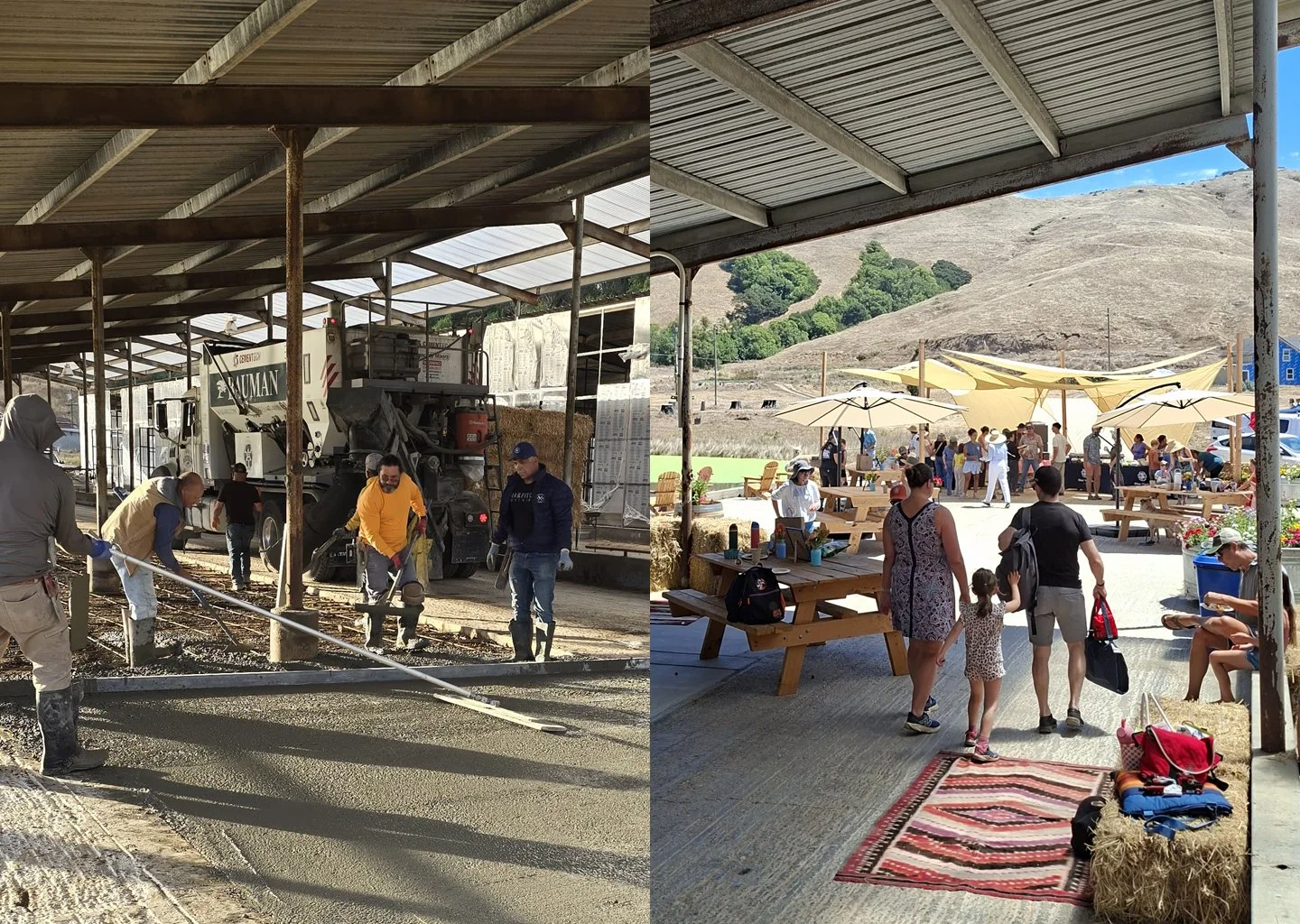
LEFT: the crew working cementing the loafing barn. RIGHT: The structure hosting the anniversary celebration with the community
Working with Susana
Rodolfo described the shift that happened when Susana, the farm’s experience designer, started shaping projects around the ranch. Early renovation work had stalled behind permits, and he could see frustration when plans stayed plans. But once attention turned to other structures, flowers, tarps, restrooms, a restored old truck repainted with color, and the farm stand grounds brought to life, momentum shifted.
“She’s brought a lot of life, a lot of color, to this place. We drive by it every day, but maybe it became invisible to us; then she arrived and gave it life.”
The anniversary celebration was one of the more demanding collaborations: disguising the restrooms without fully hiding them, figuring out shade structures, and, at Rodolfo’s suggestion, routing entrance and exit traffic through separate paths to keep things safe and stay within county rules. It required last-minute problem-solving from the whole crew, and by Rodolfo’s account, it came together as “a beautiful thing, and a real success.”
What’s next
Rodolfo’s list for the months ahead includes finishing the main structure siding and window permit, connecting more of the property’s water system to build up water reserves, building decks, painting work, and constructing more storage for supplies. The farm’s newest arrivals, a flock of sheep brought in to help manage pasture growth, are also settling in.
Asked what he’d want visitors to know about Blue Marble Acres, the thing people might walk past without noticing, Rodolfo didn’t hesitate:
“People don’t know the amount of work that is behind something like this,” he said. “Most visitors assume it’s simply a farm. What they don’t see is the years of regeneration behind every acre, and what it takes to keep a working ranch, mid-transformation, running every single day.”
As Rodolfo put it, “The ranch is still in motion.” Still moving forward, one project at a time.
Next in the water series, Part 3: Protect. Our executive Director, Matt Champoux, zooms out from the tanks and pipes to the headwaters of Walker Creek, and to what it takes to keep the water clean for everything downstream.
