

Kindness of the land: Adrian Fontaine’s story at Blue Marble Acres
Water is the thread that runs through everything at Blue Marble Acres. In this three-part series, we follow it across the ranch through three verbs: store, move, and protect. Part 1 is about storing water, and it starts with Adrian Fontaine, our land foreman, who spent five years figuring out how to catch it, keep it, and make it last through the dry months. His story begins with a run-down dairy and with water rights that did not come with the property the way he and George had assumed.
There is a particular kind of person who looks at a 772-acre former dairy, covered in manure ponds and poison oak, and see a blank canvas instead of a liability. Adrian Fontaine is that kind of person. As Blue Marble Acres’ land foreman, he is the one who gets a cal when something needs to be built, powered, or coaxed back to life. After our conversation, it is clear that almost everything on this farm, from the solar panels to the hexagonal fields to the water running underground, carries his fingerprints.
A property nobody else wanted
The story of Blue Marble Acres didn’t start with a vision. It started with disappointment.
“It was realy dirty,” Adrian remembers of the first time he and George, the farm’s owner and his friend of three decades, waked the property in the spring of 2021. It had been a working dairy, and it showed. Hazardous waste containers, old tires, structures eft to rot. They toured other properties afterward, each in worse shape than the last, and something about that comparison pulled them back.
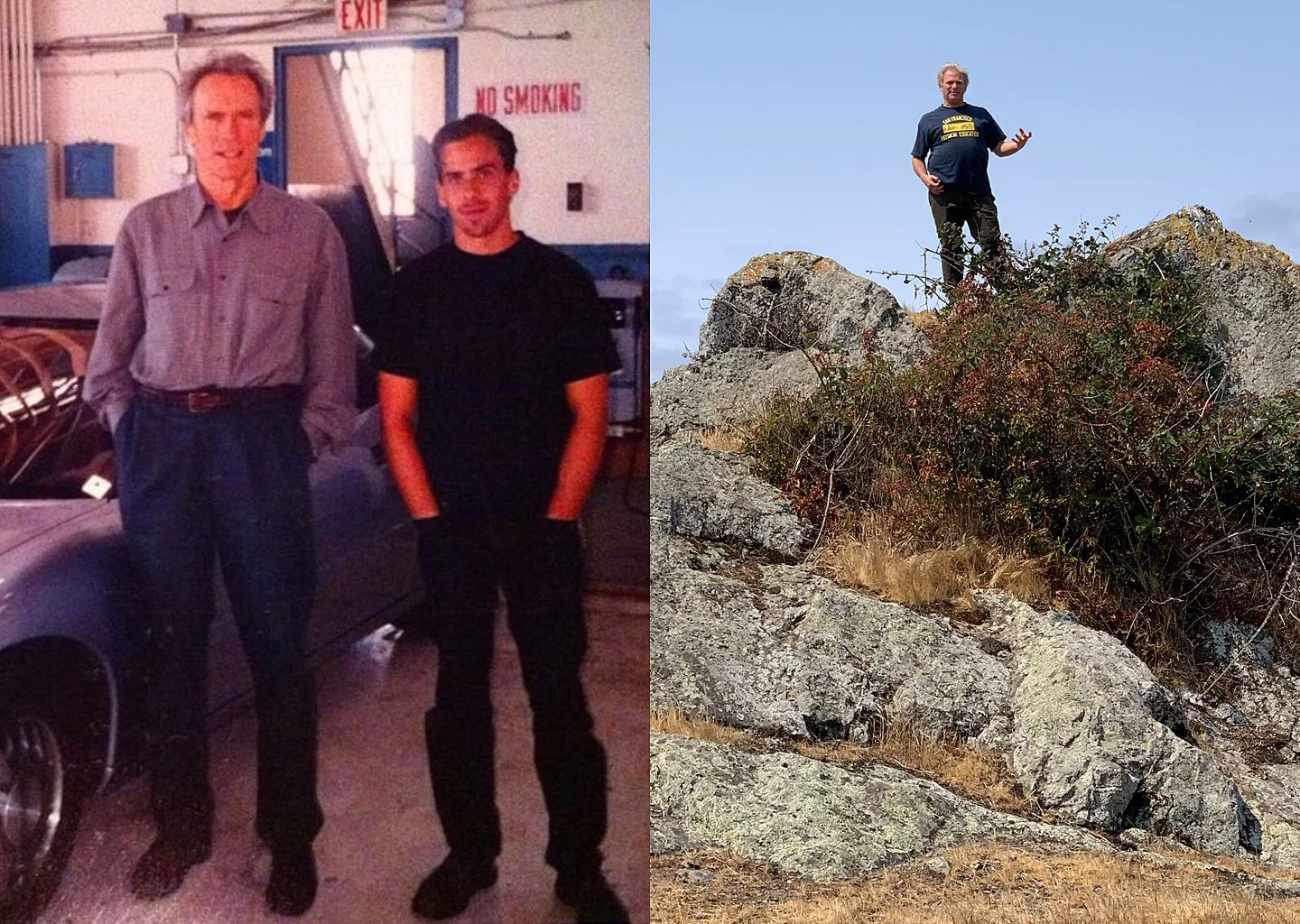
LEFT: Adrian with Clint Eastwood RIGHT: George on top of a rock looking at the property
On the second visit, they looked at the and differently. “We looked at it as more of a challenge than anything,” Adrian says. Nine miles from Novato and Petaluma, roadside, visible to the community that woud eventually watch it transform. The location made sense. But it was the condition of the soil itself, dried out from drought and worn down by years of heavy grazing, that sealed it. “This land deserves it,” Adrian thought.
There is a moment he comes back to: standing on a rock in the open field, he and George got a 360-degree view of a future that didn’t exist yet. It is the kind of image that sounds almost too clean for a true story, except that it is followed immediately by the two of them noticing poison oak creeping across the same rock. “There is going to be some challenge here for sure,” Adrian laughed. The land kept that promise ever since; nothing here has come easy, and Adrian would not really want it any other way.
The first structure went up before the ink on the sale had even dried. Adrian strung barbed wire to section off a patch of land fro roughly 800 head of cattle that still had free run of the property, a small, scrappy claim that would eventually become the farm stand. And even in the very first week, before a single row had been planted, George was already asking the question that would come to define the next five years: where is the water, and how do we keep it?
The mechanic who became a land foreman
Adrian’s path to Blue Marble Acres did not run through agricultural school. It ran through auto shops, prototype electric vehicles, and briefly, Hollywood film sets.
He started as a young auto technician working on European imports before landing a job testing prototype electric vehicles for a Norwegian car company in 1995, well before “electric vehicle” was a phrase most people used casually. When that company sold its prototype to Ford and his job dissolved, Adrian found himself in Alameda, near old naval hangars that film productions had taken over. A chance encounter, tires screeching, a black town car, and a conversation with Clint Eastwood about a future electric sports car turned into a job in transportation on a Don Johnson production, and eventually into stunt work and acting.
It is a wild detour, but Adrian describes it less as a departure and more as a thread: a mechanical mind, a willingness to chase an opportunity, and an early, hands-on education in what combustion engines cost the planet. When George came back into his life, and Adrian moved into real estate, the two eventually found their way to a rough piece of agricultural land in Calistoga, the property that came before Blue Marble Acres. It had no power infrastructure, just an unpowered well. That’s where Adrian taught himself solar and off-grid energy systems, almost by necessity.
“Everything we did on that land kind of prepped us for what we did here at BMA.”
Outside of work, Adrian’s relationship with nature has a different, quieter origin in gold mining with his father. A friend introduced him to it on a whim one slow afternoon by a river near Auburn, and something about the sound of moving water and the smell of the trees clicked instantly. He called his dad, and the two of them turned it into a ritual, eventually buying their own claim. His father passed two years ago, and Adrian has not been back to the river much since, but he calls it the thing that “connected me to nature more than anything else ever has.”
These days, the same calm shows up closer to home, with his wife Anita and their 178-pound Great Pyrenees, Dalton, a dog who was nearly out of options at a shelter in Bakersfield before George brought him home, and who quietly adopted Adrian as his person.
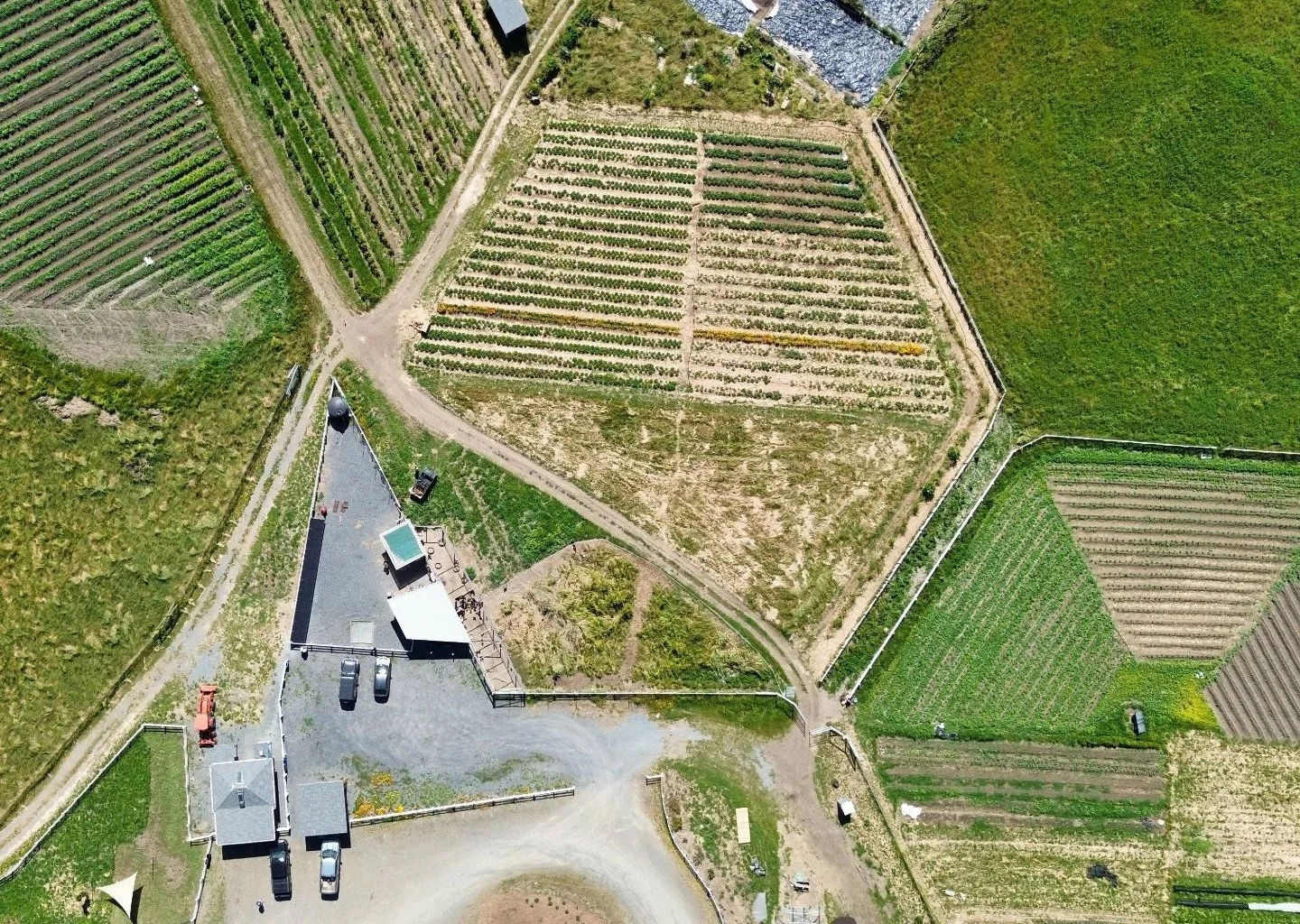
Aerial view of the farm stand and the hexagonal fields
Building the bones of the farm
Ask Adrian what he is proudest of, and the list is long, but it starts with the farm’s off-grid solar system, a necessity turned into a point of pride, powering the farm stand without ever pulling a line from the grid, and the hexagonal field design that anchors the farm’s regenerative approach.
The pattern came from, of all things, a honeycomb. Adrian split the heavily compacted dairy soil into six wedge-shaped plots, rotating root vegetables through them year over year so each plot slowly loosens and rebuilds itself before the next crop arrives. The first carrots they grew came out small and crooked in compacted soil; years later, in the same soil, they grew straight. One hexagon, properly rotated, can sustain decades of planting. Six hexagons, connected in a ring around a shared central gathering space, became the farm’s agricultural and communal heart, a design Adrian hoped might double as an amphitheater for movie nights under the stars.
But Adrian doesn’t linger on the engineering. He lingers on a single afternoon about a year and a half ago, when he and George stepped out the back door of the farm stand in a slow moment and watched a young family picking strawberries, bent over in the dirt.
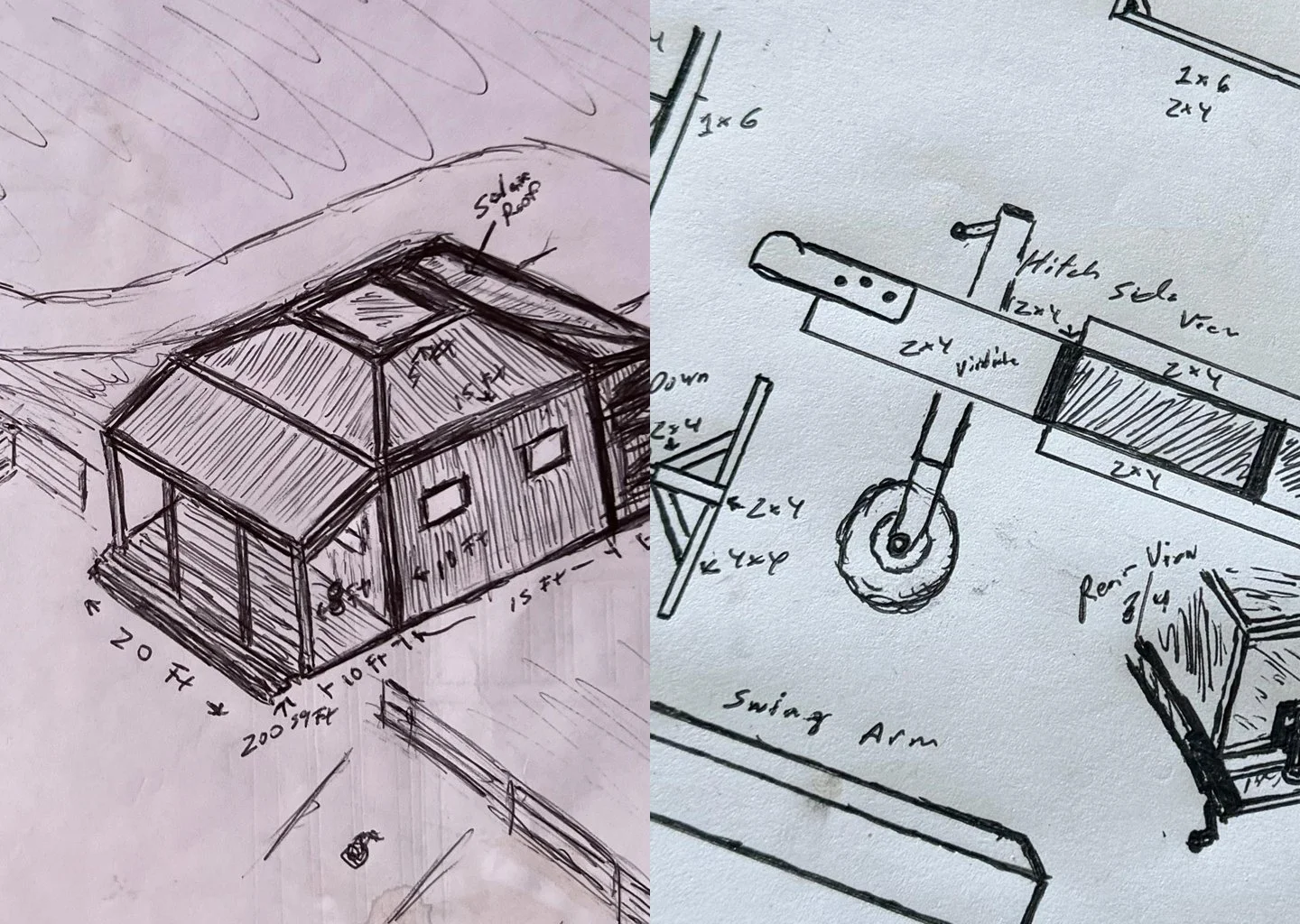
LEFT: Sketch of the farm stand. RIGHT: sketch of the chicken tractor.
“This is what we are really trying to accomplish; this is the important part.”
The generosity of the land: learning to store water
If there is one topic that has tested Adrian more than any other, it is water, and he does not dress that up. California’s water rights didn’t come with the property the way he and George assumed they would, and the first growing season meant literally driving a thousand-gallon tank back and forth to feed a single acre by hand.
The turning point came when they drilled into a horizontal spring, and the water came rushing out faster than anyone expected. With help from a neighbor, the team scrambled to bring in enough tanks in a matter of hours to capture nearly 20,000 gallons without wasting a drop. “It is the blood of the land,” Adrian says. “We ought to make sure it flows in the proper way.”
That instinct, to protect first, expand second, now shapes everything from where pipes are buried to how old manure ponds have been cleaned out and repurposed as rainwater catchments, giving the farm enough reserve to weather dry summers. Even the farm’s lake, stocked decades ago by the previous dairy operation, has found new purpose: fish from that lake now seed other water catchments on the property, helping control mosquitoes and enriching compost, in what Adrian calls “a nice little circle.”
Storage, in other words, is not one tank or one pond but a whole network: a spring, buried pipes, rainwater catchments, and a lake that seeds them. But catching water is only half of the job. Getting it to where food grows, without wasting energy or losing the way, is a different craft, and it belongs to someone else on the team.
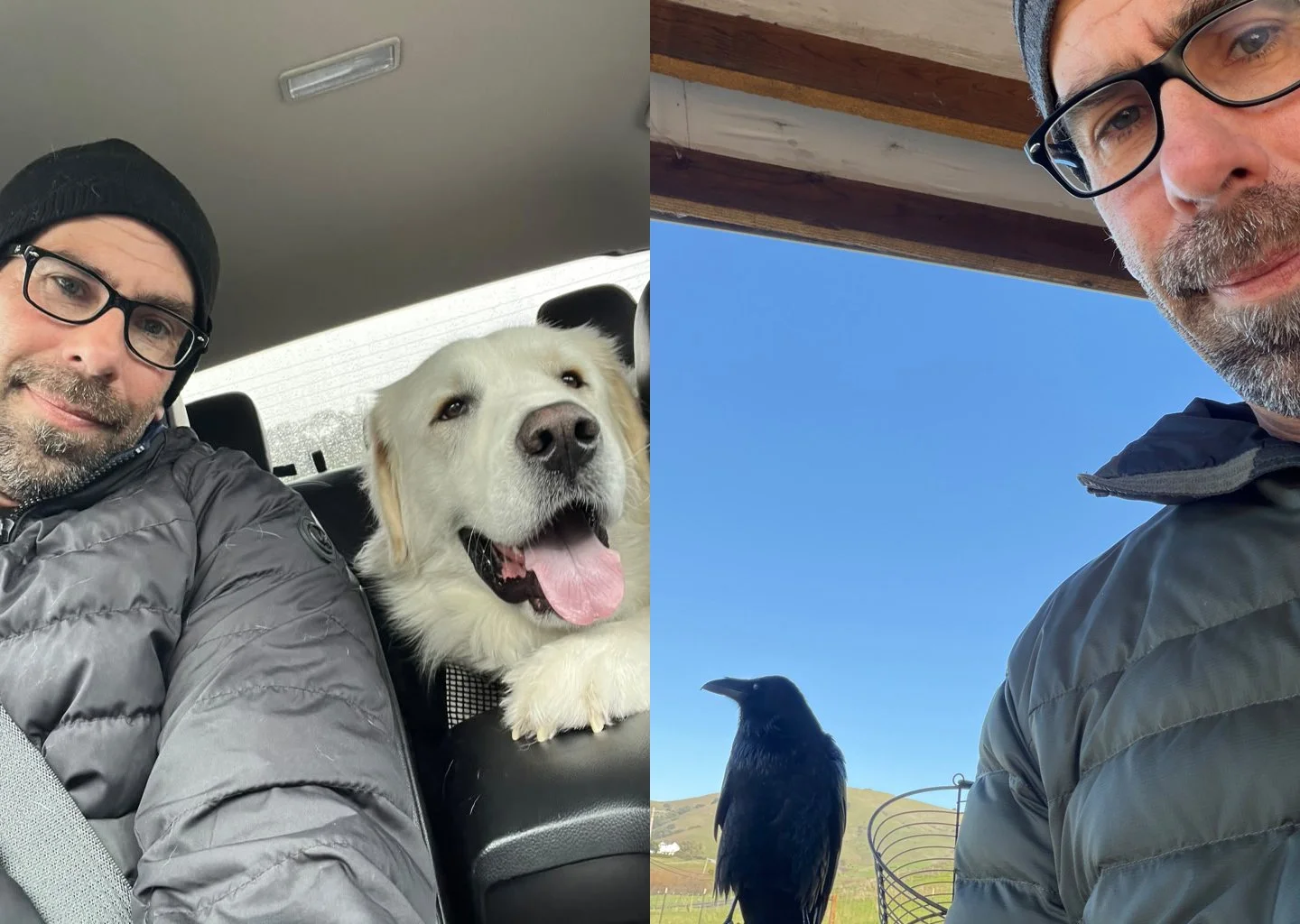
LEFT: Adrian with his dog Dalton. RIGHT: Adrian with a friend, a bird named Phill, who comes to the farm stand to eat from time to time.
What comes next
Adrian’s vision for the farm’s future is not really about acreage or yield. It is about teaching, hand in the soil, kids learning where food actually comes from, people reconnecting with something he worries is slipping away a generation at a time. Lately, that instinct has found a new home in the farm’s woodshop, where century-old cypress trees removed for safety reasons are being milled into benches, birdhouses, and cutting boards instead of discarded. It has become, in his words, “my little sanctuary.”
Standing on the hill behind the farm stand, looking at what is built, Adrian put it simply: people driving past Blue Marble Acres used to smell manure and see neglect. Now they see something growing in a positive direction. That, more than any system he has engineered, is the word he hopes sticks: not efficient, not impressive, just kind.
Next in the series, Part 2: Move. Meet Rodolfo, who leads our construction and infrastructure crew and keeps water flowing across the ranch, mostly by gravity.
