A promise on a beach in Costa Rica grew into 111,000 trees
At Blue Marble Acres, we believe in projects that give back to the land, to the people, and to the communities around them. That’s why we wanted to introduce you to a project close to our heart: Costas Verdes, a nonprofit in Costa Rica that has spent the last 16 years bringing trees, shade, and life back to the country’s coastline.
I sat down with Gerardo Bolaños, Executive Director of Costas Verdes, to learn how it all started, what it really takes to reforest a beach, and why a single planted tree can change more than just a landscape.
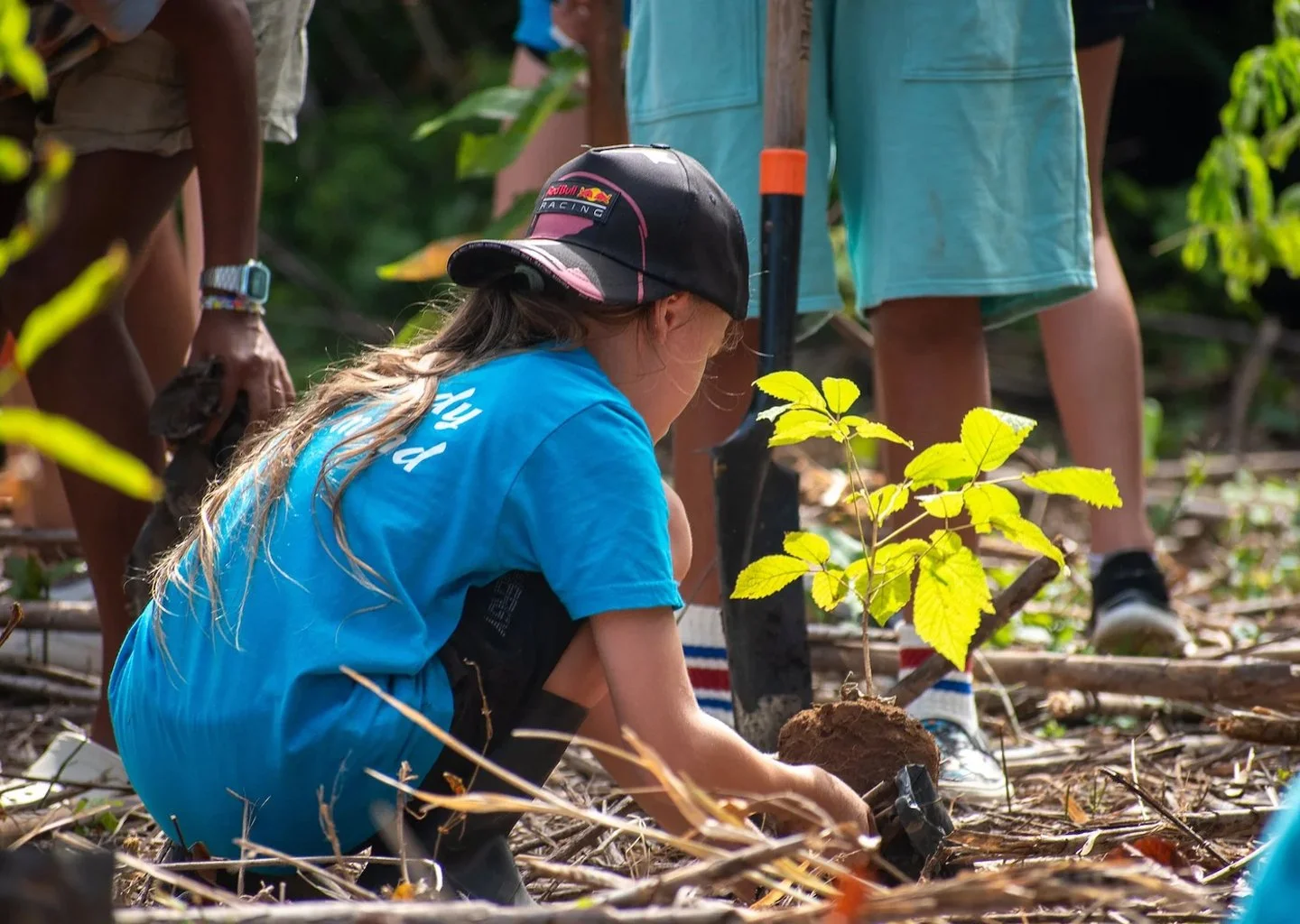
A student part of a reforestation event planting a new tree in the coastline.
A promise made in love
Every good story has a beginning, and this one starts with a promise.
Costas Verdes was founded by Max Tattenbach, an agronomy student from San José who loved to surf. Every weekend, he made his way to Playa Hermosa, one of Costa Rica’s most famous surf spots, two hours from the city, with world-class waves. But the beach had a problem. It had once been used for cattle and farming, and after the animals were removed to protect sea turtle nesting grounds, aggressive plants and grasses took over. Nearly all the shade was gone, except for one lone almond tree that every surfer fought over.
Max’s girlfriend, Gala, didn’t surf. She came along for the weekend and needed somewhere to sit and read, but there was almost no shade to be found, and Playa Hermosa’s dark sand heated up fast. She kept getting sunburned.
So Max made her a promise: he would plant shade across the entire beach.
That promise turned into a mini nursery near the wildlife refuge, a handful of committed friends, and eventually a full nonprofit. Costas Verdes officially became an association in February 2009, though the very first trees went into the ground in 2010.
Gerardo’s own story joined this one a year later. He had moved to Nosara to work at a hotel, and the day he arrived, he walked a small trail to the beach to surf, a trail with almost no trees left, just grass and open sand. The waves were perfect and empty. Standing there, something shifted in him.
“I felt something break a little inside me, I felt like this was my new home, and that I had to do something about it.”
He started collecting seeds and growing trees on his own, long before Costas Verdes ever reached Nosara. When Max eventually arrived there looking for a reforestation partner, it felt, in Gerardo’s words, like finally getting the tool he’d been waiting for.
What it really takes to bring a forest back
Reforesting a coastline sounds simple: dig a hole, plant a tree, done. It isn’t.
Gerardo explained that coastal forest took thousands of years to form, shaped by salt air, big waves, storms, and shifting sand. It’s a harsh environment, and once it’s cleared for cattle or farming, the soil loses its nutrients, erosion increases, and aggressive weeds and grasses move in fast, crowding out anything trying to grow back naturally.
That means reforestation is not a one-time event. It takes years of ongoing care: clearing invasive species, rebuilding soil health, protecting young trees from foot traffic, dogs, horses, hammocks, and parked cars, and maybe hardest of all, choosing the right native species for each specific beach. What works on one stretch of coast might not survive on another just a few miles away.
The first planting in Nosara mostly failed. The team learned through trial and error which species could actually survive the region’s long dry season. It took years to get it right, but the community’s enthusiasm never wavered, and that support became the foundation everything else was built on.
Gerardo also pointed out something easy to miss: not every beach gets the same kind of protection. Playa Guiones, for example, is part of a wildlife refuge, but the refuge was really created to protect sea turtle nesting sites nearby, not the beach forest itself. That means government resources are stretched thin, and there is very little official oversight of the reforestation work itself. In practice, that leaves organizations like Costas Verdes and the communities who support them to carry most of the responsibility for bringing these coastal forests back to life.
As Costas Verdes proved their model worked in Playa Hermosa and Nosara, word started to spread along the coast. Other communities began reaching out on their own, asking for help starting similar projects. That’s how the organization grew, not by chasing new beaches, but by beaches coming to them, one relationship at a time, from Jacó and Herradura to Esterillos in the Central Pacific, to Pelada, Garza, Avellanas in the North Pacific, and beyond.
Trees that grow roots in people, too
When I ask Gerardo what a successful restoration event looks like, his answer surprised me.
“For me, a successful reforestation campaign is one where I have to plant the fewest trees possible myself,” he said. “I only want to plant one tree, the first one, to show people how it is done. After that, it is their tree to plant.”
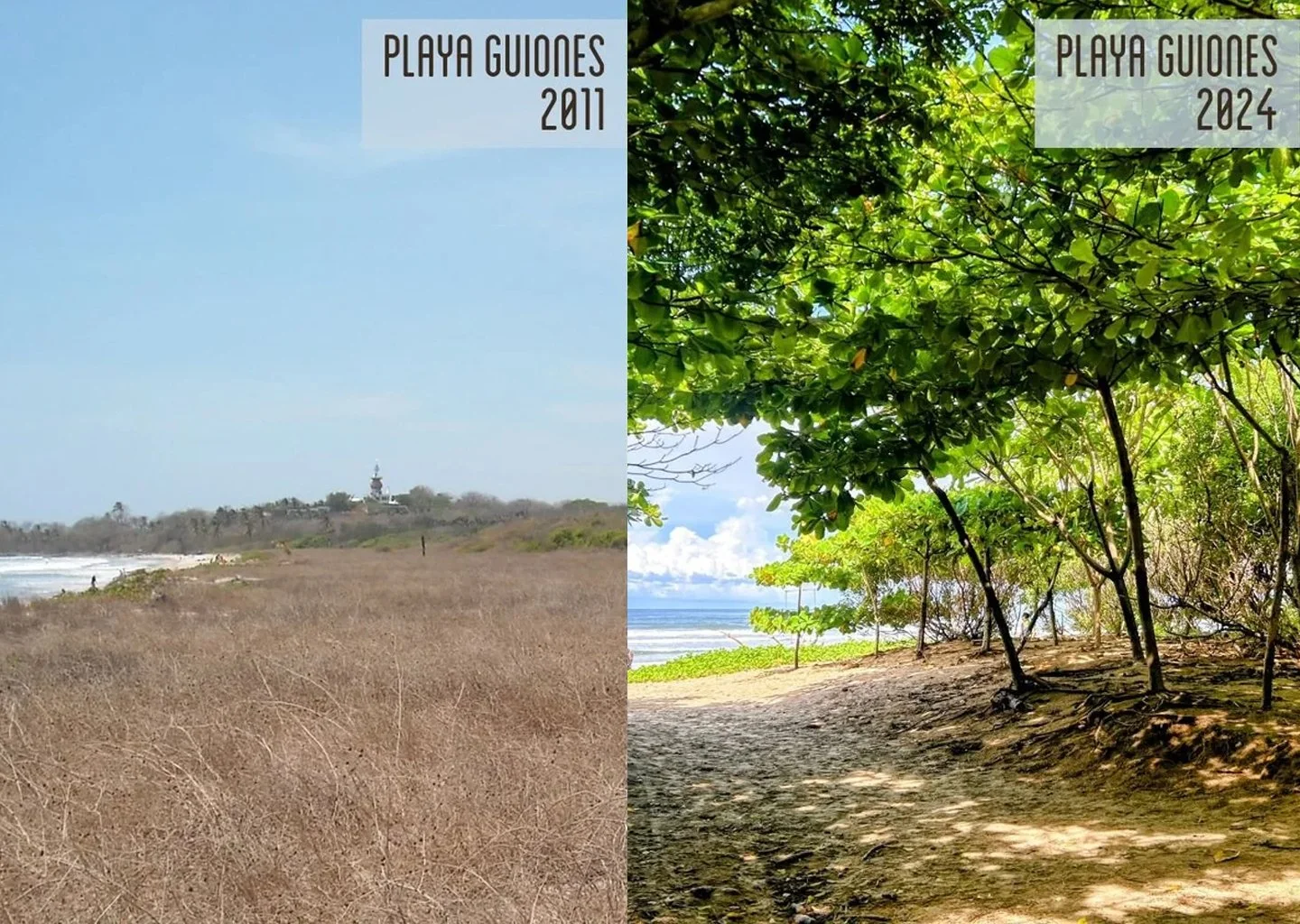
LEFT: Playa Guiones back in 2011, without trees. RIGHT: The same coastal point in Playa Guiones in 2024, with a forest.
Schools, volunteers, and local communities have been part of Costas Verdes from day one. Because beaches are public spaces used by everyone, Gerardo says the only way trees survive long-term is if the people who live nearby understand what they are protecting and feel some ownership over it.
For Gerardo, the real goal is not the tree count; it is the experience. He wants every volunteer, whether it is a child, a grandparent, or a tourist on vacation, to walk away feeling like they were part of something bigger than a photo for social media. He hopes that planting a single tree can plant something else too: a sense of responsibility toward the coast that stays with a person long after the event ends.
That’s where the real magic happens. Gerardo has watched first-time volunteers come back again and again, eventually becoming informal ambassadors, recruiting friends, giving talks, organizing tools and local support. Interestingly, most of these repeat volunteers are foreigners living in the area rather than locals, something Gerardo is refreshingly honest about. It is a real challenge for a project that’s meant to be community-driven: convincing the people who live there full-time that this is worth their Sunday morning too, not just something for visitors.
In Playa Avellanas, one community even started building nature trails on their own, without being asked, years earlier than Gerardo expected. When he saw it happening, his reaction was not to take control, but to ask how Costas Verdes could support what the community had already started.
“That’s exactly the point of Costas Verdes: to find communities who take the little seed we planted and grow bigger than we ever could on our own.”
Partnerships built on a shared vision
Costas Verdes has grown through partnerships, with hotels that donate nursery space, organizations that provide funding, and communities that show up year after year. But Gerardo is clear about what actually makes a partnership work.
“It is not about the size of the partner, local, national, or global,” he said. “What matters is whether the vision is shared.”
That shared vision is exactly what is drawing Costas Verdes and Blue Marble Acres closer together. Both projects believe deeply in bringing communities closer to land restoration, whether that is a ranch in West Marin rebuilding healthy soil after decades of grazing, or a stretch of Costa Rican coastline recovering its native forest. As Blue Marble looks toward a future project in Costa Rica, the connection between these two missions feels less like coincidence and more like planting a seed for something bigger.
A goal of 300,000 trees and an invitation
Costas Verdes has already planted more than 110,000 trees, reintroduced 96 native species, and worked across more than 43 beaches and communities. But Gerardo and his team are not slowing down. Over the next five years, they are aiming to plant 200,000 more trees, bringing the total to 300,000, and to expand their work to 100 beaches across Costa Rica. They are also pushing for stronger legal protection of coastal dry forest, working to reconnect beach forests with river systems further inland, and exploring ways for coastal development companies to help offset their impact by funding new restoration projects.
I asked him what keeps him going after 15 years, and Gerardo doesn’t talk about numbers.
“If I can offer someone else even a little bit of the understanding this work gave me, I’ve done what I set out to do,” he said.
If this story moved you the way it moved us, there are simple ways to get involved. You can follow Costas Verdes on social media, adopt a tree, or donate directly to support their work in Playa Guiones and beyond. If you are ever in Nosara, they run a WhatsApp group for volunteers and welcome anyone who wants to show up for a planting day. And if you simply know someone who might want to hear this story, share it, because as Gerardo told me, every bit of awareness helps a tree take root.
Blue Marble Acres is proud to call Costas Verdes a kindred project, different coastlines, same roots.