A human from the soil up
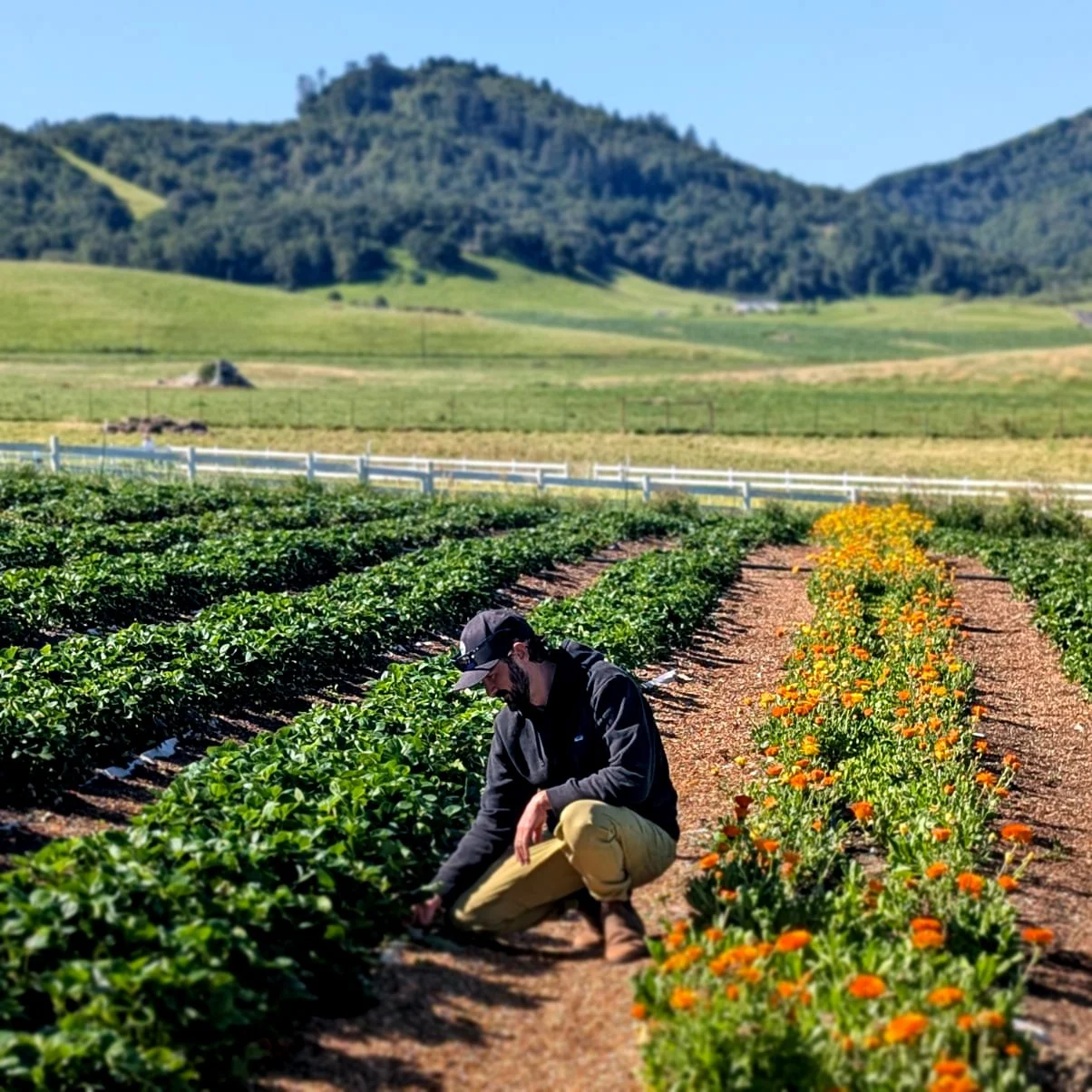
Edgar at the farm checking the crops during spring season.
This article was written based on a conversation with Edgar Cox, the Agricultural Manager at Blue Marble Acres.
Edgar Cox doesn’t fit the mold of a typical farm manager, and that is what makes him remarkable. A former clinical psychologist from Miami, a winemaker who honed his craft from New Zealand to California, a surfer, climber, snowboarder, and fisherman, Edgar brings a rare mix of disciplines to West Marin. Today, as Agricultural Manager at Blue Marble Acres, he is leading a vision of farming that goes far beyond what grows in the ground.
We sat down, we talked about the journey that brought him to the farm, the philosophy that drives his work, and what he believes the future of farming and our community can look like.
The origin story | From Miami to the soil
Edgar grew up in Miami, where the ocean was not just a backdrop but a way of life. He surfed, fished, spent time on the warm coastal waters, and at one point even worked as a professional fisherman. But alongside that life by the sea, he pursued an academic path that led him into the human mind. He studied psychology, eventually practicing clinical psychology with a focus on young children, including kids on the spectrum. “I really considered myself an empath”, he reflects. “Working with kids required a lot of that.”
The pivot to California came through his wife, originally from Colombia, who made the move first. Edgar followed and found himself in a culture that felt noticeably different from the ‘loud energy’ of Miami. California was more structured, more measured. But he adapted, and that adaptability would become one of his most defining traits. With his social intelligence, Edgar found his way to the wine industry. He began learning the full arc of winemaking, from soil to bottle, and discovered a passion for the land that would quietly reshape his entire journey.
The winemaker’s eye
Over nearly eight years in wine production, Edgar worked across scale, from large commercial operations to boutique labels, and everything in between. He spent time in New Zealand, where the precision demanded by premium winemaking sharpened his attention to detail and instilled a deep respect for the complexity of agricultural systems. “That experience taught me to pay attention to every aspect of my work,” he says. “Every task matters, every detail connects to the final product.” It is an approach he carries directly into his leadership of Blue Marble today.
The Psychology of leadership
Edgar’s background in psychology is not just a chapter in his past; it is an active resource in his daily collaboration. He pushes for creative solutions and applies the same knowledge when dealing with team members, especially when each requires a different leadership approach.
“Some people respond to actions, some need softer conversations. You have to read people and adapt.” Equally important to him is his own mental and physical well-being. He believes that showing up clear-headed and grounded is not a luxury but a responsibility, both to himself and to the people who work alongside him.
A ballet class that changes everything
The story of how Edgar joined Blue Marble Acres is the kind of origin story that feels almost too cinematic to be true. He met George (BMA’s founder) at their kids’ ballet classes. At the time, Edgar was still deep in the wine world, and George was in the early stages of envisioning what would become Blue Marble Acres.
What Edgar found compelling was not just the concept of the farm. It was George’s mindset. “He is experimental. He is not afraid to try things. Failure is not a setback; it is part of the process.” That philosophy resonated deeply with Edgar, who saw in George a kindred spirit willing to explore new territory without a predetermined map.
At the time, the land that is now Blue Marble Acres was a cattle and dairy farm. The transformation to what it is today, a diverse organic operation, has been a conscious, ongoing act of regeneration.
Scale and Complexity
Ask Edgar about the hardest part of running BMA’s operation, and the answer might surprise you. It is not the harvest, it is the planting.
“Planning and planting require not just precise preparation, but the ability to adapt almost instantly,” he explains. He offers a vivid example: soil prepared and ready, seeds set to go into the ground, and then an unexpected rain event rolls in. Everything has to pause, be reassessed, and the soil reworked before planting can resume. It is a reminder that in agriculture, nature always has the final word.
Safety first, always
On the question of team dynamics, Edgar is direct and transparent: he will never ask anyone on his crew to do something he has not learned himself. Safety is not a policy. It is a principle that comes from personal conviction, and from witnessing what leadership without that ethic looks like.
“People first” is not a slogan at Blue Marble Acres. It is the operating framework.
Natural way to control the farm
One of the most memorable stories Edgar shared is a small-scale example of ecological problem-solving. When bugs began attacking the strawberry crops, the conventional response might have been to reach for a certified pesticide. Edgar’s response was different.
He planted flowers between the crop rows, specific blooms that bugs prefer over the berry. The bugs migrated to the flowers, and the strawberries were saved, without chemicals, without compromising the organic certification goal.
“Even products labeled as certified organic, I’ve seen enough to know there is no 100% validation on that. I’d rather trust our solution.”
This kind of ecological intuition, informed by years of study and hands-on experience, is at the core of how Edgar manages the farm’s integrity.
Tech and intuition: a hybrid approach
Edgar uses sensors to monitor conditions to produce, track water intake with the help of agricultural apps, and values what data can reveal. But he also walks the farm. He kneels down, presses his hand into the soil, feels its moisture, and reads its texture.
“You can have all the data,” he says, “but sometimes you just need to touch the ground.” That balance, between what a screen tells you and what your hands tell you, is how he makes decisions day after day.
Beyond regenerative agriculture
For Edgar, organic certification is a goal, but he is careful to note that the term means different things to different people. At Blue Marble Acres, regenerative means something holistic: it is about the health of the soil, yes, but also about fair wages for the people who work it, and nutritious food arriving on the tables of those who eat it. The land, the farmers, and the consumers are seen as one interconnected system.
“Food is medicine. What we grow here, we grow with intention, for the land, for the people who tend it, and for the people who eat it.”
The future of farming
Edgar can already see the results of this philosophy playing out in the land itself. Over the last five years, the farm has grown visibly greener. The quality of produce has improved. The soil is responding. And that improvement, he believes, is directly traceable to the ethic behind the work, doing right by the land and the people on it.
When asked to look ten years ahead, Edgar does not see a binary between automation and a return to ancestral methods. He sees a hybrid, and something more personal. “I see myself buying from local farmers. I see people getting to know who grows their food, why it matters, what is actually in it.” In his vision, the future is not defined by what technology replaces, but by what relationships are restored. Between grower and consumer. Between land and community.
The social harvest
The impact of Blue Marble Acres extends beyond what grows in the ground. Edgar speaks with evident pride about the farm’s ongoing practice of donating food to community centers, produce that, for many people, represents a quality of nutrition they might not otherwise be able to access.
“Knowing that this food is going to someone’s table, good food, real food, that is a purpose I don’t take lightly.”
Grounding practice
Edgar surfs, climbs, snowboards, and fishes. These are not just hobbies, they are, in his words, how he processes the world. Solo sports that demand presence, resilience, and a relationship with forces beyond your control.
“When you practice these sports, you are not thinking about anything else. You are just there.” That clarity, he says, carries back to the farm. A grounded manager leads a grounded team. A grounded team tends to grounded soil. And grounded soil, tended well, yields something extraordinary.
A legacy written in the land
Perhaps the most moving moment of our conversation came when Edgar described a recent meeting at the farm with a new partner. The visitors mentioned they had been driving past the BMA’s land in recent years, and they had watched it change. More green. More life. Different energy. They could see it from the road.
“I want to leave this land better than I found it. That is the legacy that matters to me.”
At Blue Marble Acres, that legacy is already being written, in the soil, in the strawberries, in the flowers planted strategically between crop rows, in the food donated to community centers, and in the quiet, daily work of a team led by a man who once counseled children and now tends the earth with the same depth of care. The land is listening, and it is responding.