

A shepherd on a mission: healing the soil
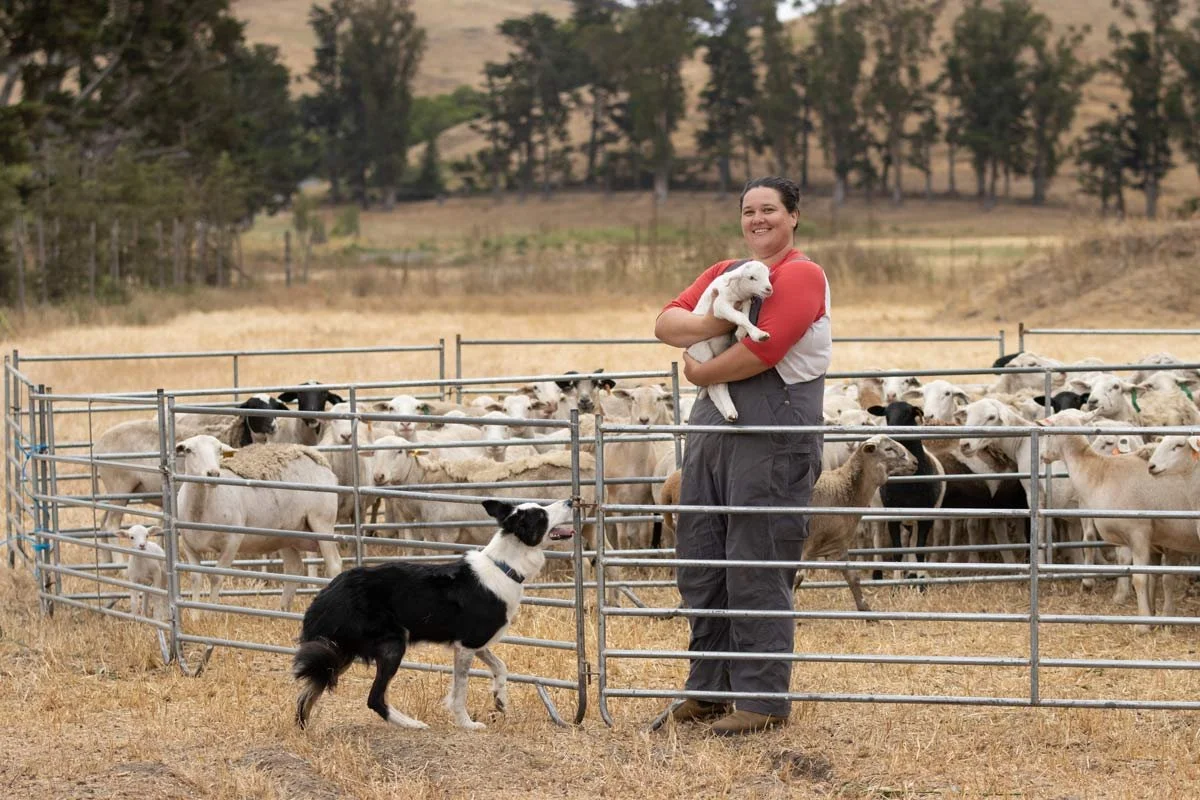
An image from MALT’s website featuring Jenna holding a sheep, and fenced flock, and a dog.
If you’ve noticed the hills around Blue Marble Acres looking greener lately, there’s a good reason, and it has four legs.
Jenna Coughlin is the founder of Shepherds of the Coast, a prescribed grazing operation working with us here at Blue Marble since January 2025. Her flock of Katahdin-Dorper cross sheep is not just grazing the land. They are restoring it.
From cheesemaking to open pasture
Jenna’s path to shepherding is not a straight line, and that’s what makes it interesting.
She spent nearly five years in the cheesemaking world, starting as a farm apprentice at Tomales Farmstead Creamery, where she worked with both sheep and goats. Quickly rose to head cheesemaker. She loved the craft, the chemistry, the seasonality, the way the cheese changed depending on what the animals were eating, whether it was mating season, or how much rain had fallen that month.
But cheesemaking meant being indoors, in a clean room, eight hours a day. And Jenna had come to sustainable agriculture to do the act of agriculture.
The turning point came through a week-long workshop, a collaboration between the Grazing School of the West and New Cowgirl Camp, designed to provide the next generation of land stewards with the skills, business knowledge and community to make it on their own.
“At the end of that week, I was like, ok, I can do a grazing company,” she recalls. “All of the barriers that were in my mind up until that point were very much dissolved. The only trick to doing it is doing it.”
She spent the following months sourcing animals, developing contracts, and finding a home base. After a couple of false starts, everything aligned with a flock of sheep that were not fully utilized. Animals that deserved more attention, more intentional management, and a better purpose. That starter flock came bundled with a first contract. That contract was at Blue Marble Acres.
What is prescribed grazing, exactly?
When most people hear the word “grazing”, they picture cattle wandering across vast open rangeland. Prescribed grazing is something fundamentally different.
Jenna moves her flock through small, carefully planned paddocks at high density, for short bursts of time, then moves them on, giving the land time to recover. It is targeted, intentional, and measurable. Think of it as grazing with a plan, not just a pasture.
“It is intentionally high density, short duration, versus low density, long duration, which is what you see in a more conventional ranching system”
The impact goes well beneath the surface. When sheep graze and trample an area, their hooves press organic material directly into the soil. Their manure adds nutrients. The grazed plants, rather than dying, send energy down into their roots, stabilizing the soil, improving its capacity to hold water, and building resilience against erosion and wildfire.
Unlike herbicides, grazing does not kill the plant. It triggers the plant to grow stronger, driving roots deeper, locking in moisture, and building the kind of soil health that makes a landscape more resilient during dry seasons and fire events. It is also why California officially recognized prescribed grazing as a wildfire prevention strategy in 2024. A landmark acknowledgement that is opening landowners’ eyes to both the ecological and economic value of the work.
Jenna raises Katahdin-Dorper crosses specifically because they are hair sheep, meaning their wool naturally sheds once a year, saving her the cost and complexity of shearing, a significant advantage in a U.S. market where wool prices rarely cover the cost of processing.
The partnership with Blue Marble Acres
The relationship between Shepherds of the Coast and Blue Marble Acres started before it was even Jenna’s relationship.
Her flock had already been grazing at the farm under a previous agreement with a friend of hers. When Jenna took over management of the sheep, she inherited the contract and found something she was not expecting: a farm team that shared her values almost completely.
“They see the need for livestock integrated into a farm system, and I can really see the value in a diversified farm and the way they open up land access for other small producers.”
Now in year two, the picture is becoming clearer with every season. Jenna tracks which plants the sheep prefer at which time of the year, poison hemlock in one season, thistles in another, and uses that knowledge to time their movements more precisely. She has noticed that when thistles are chopped and left on the ground for a couple of days, the sheep go absolutely crazy for them. Nutritionally similar to alfalfa, thistles that most landowners consider a nuisance become premium forage in the right hands.
Edgar, Blue Marble’s agricultural manager, has been watching the changes closely, noticing shifts in soil texture where the flocks have worked, and neighbors driving past on the Petaluma Road have started asking questions, because the hills are visibly greener.
The flock is currently co-owned between Jenna, Truegrass Farms, and Blue Marble Acres, with a long-term goal for Jenna to eventually buy back full ownership, giving her more flexibility and independence as the business grows.
A wider conservation network
Shepherds of the Coast does not operate in isolation. It sits inside growing web of relationships tht spans farms, conservation organizations, and community partners across Marin and Sonoma counties.
This year, Jenna received a grant from MALT (Marin Agriculture Land Trust), through their Building Resiliency In Marin’s Working Lands Program. For a business only in its second year, that kind of institutional support carries a big weight, not just financially, but as a public signal that this work matters.
“MALT has been a huge help in developing my business, not just for the grant itself but for the public-facing reach. They invite me to speak at donor and volunteer events. It really shows me the validity of the work, which is reassuring and helps everything keep going.”
She also holds a FARE grant through Marin County Parks, which will fund. two public education events, giving community members a chance to see prescribed grazing up close, ask questions, and connect with the land in a new way. Dates are still being confirmed. Follow Jenna’s Instagram account for news and updates.
Her partnership extends across vineyards, orchards, ranches, and conservation land throughout the region. She finds that the common thread among all her clients is not a specific ideology; it is a shared desire to move away from diesel-dependent land management.
Her relationship with Truegrass Farms, just across the road, is another model worth noting. Owner Guido needed someone to focus on his sheep, and Jenna needed animals to build her business. What grew out of their friendship and proximity became a genuine working partnership, the kind of collaborative generosity that makes small-scale sustainable agriculture possible.
The bigger picture
Jenna is not dreaming of scaling into a large corporation. Her vision of success is quieter and more lasting.
“My goal is to be able to keep doing this work throughout my life, and to help steward a next generation of shepherds.”
She points to one of agriculture’s most pressing problems: the aging farmer. Too many ranches and farms have no one to hand the reins to. What Jenna wants to see and is actively working to build is a culture of generosity between established farmers and those just starting out. The kind of relationship where someone more experienced opens a door, offers their trust, and both end up stronger for it.
For young people drawn to regenerative agriculture, and especially those from indigenous or underrepresented communities, she recommends programs like the Grazing School of the West and New Cowgirl Camp, both of which offer scholarships and accessible payment plans. The ATTRA database is another starting point for finding sustainable agriculture internships across the country.
As a member of the Coast Miwok people, working on her ancestral land, Jenn sees all of this through a lens that goes beyond any single season or business cycle. Long before fences changed the landscape, large herds of grazing animals were the primary ecological managers of these rolling hills. In her work, she sees a way to bring some of that natural rhythm back.
“We are still on the same hills,” she says. “There are some of our same plant relatives and animal relatives out there in the world with us.”
The sheep are grazing. The soil is healing. Next time you are at Blue Marble Acres, keep an eye on the hillsides. That leapfrog pattern of fencing moving slowly across the pasture? That’s Jenna’s work in progress. And if you spot a bold ewe who earned herself a name, that’s the amazing Rhonda, she earned it!
Shepherds of the Coast will soon be offering public education events through a Marin County Parks Fare grant, giving anyone curious about prescribed grazing a chance to see it up close. Stay tuned for dates.
Want to learn more about Shepherds of the Coast? Visit their website or follow Jenna’s work through MALT’s network. And finally, remember that public education events are coming soon! Stay tuned!
