

A water storage solution powered by 400 students
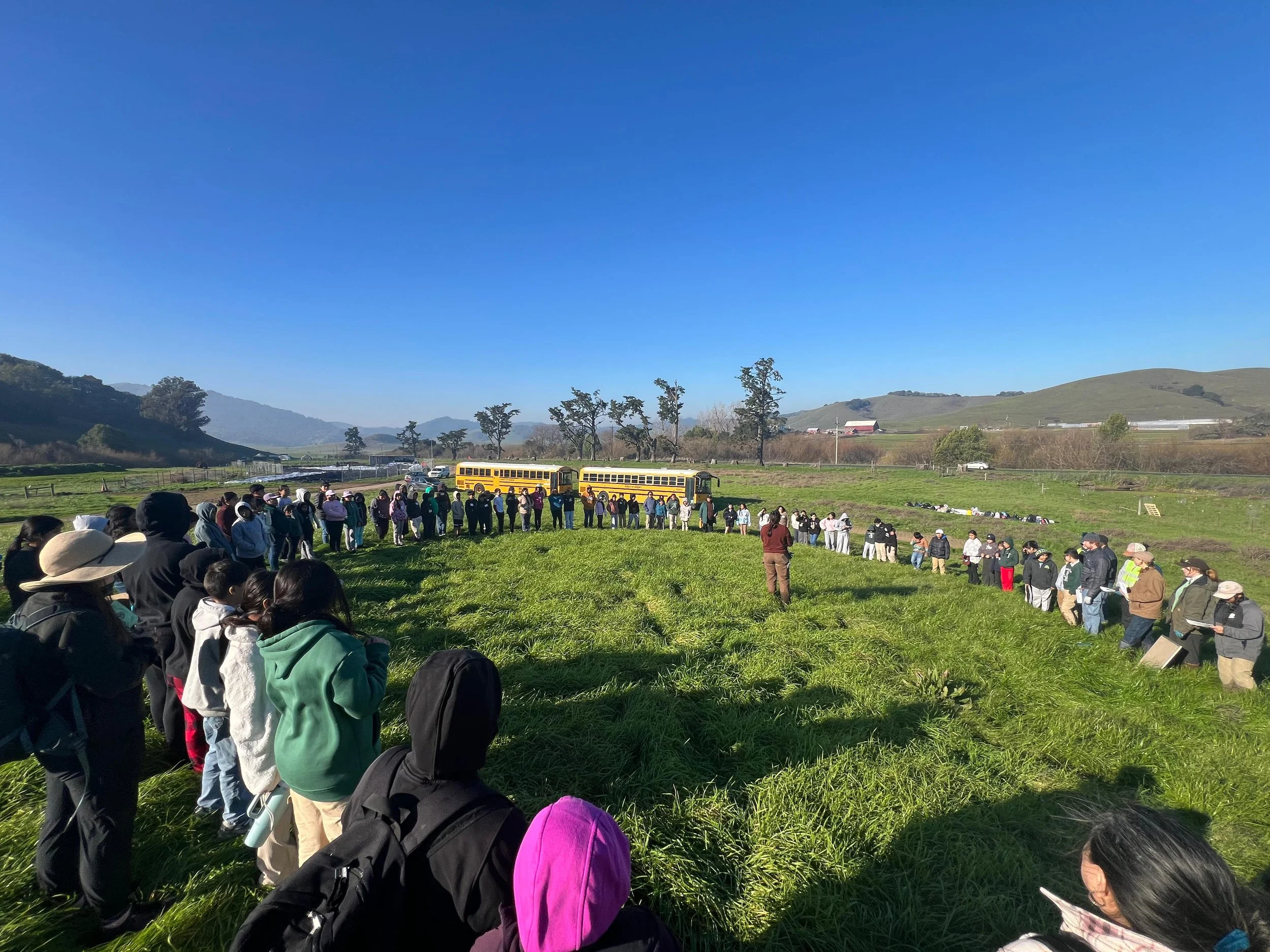
Circle of students and volunteers at the Blue Marble Acres in their last visit 27th March, 2026
There is a corridor of land at Blue Marble Acres that runs from the front of the property all the way back to the main road. Until recently, it was an open, seasonally flooded stretch, bare of the native trees and shrubs that once would have lined it, cleared out over generations of ranching, and quietly waiting. We call these “blue lines” on the property: the paths where water moves, and this one had been on our radar since the very beginning.
This past season, with support from the Marin Resource Conservation District and in partnership with STRAW (Students and Teachers Restoring a Watershed) that blue line finally got the attention it deserved. Over the course of three months, more than 400 students cycled through the farm to help us bring it back to life.
The importance of a corridor like this
We have three main riparian corridors running through the property, and choosing where to start wasn’t arbitrary. The MRCD and STRAW teams came out for a walk about a year ago, and after assessing the land together, the reasoning was clear: this corridor was accessible, visible to the public, and - crucially - it connects directly to another tree-filled riparian zone on the other side of the Petaluma road.
“If we bring this line down, all of the sudden birds and animals have this opportunity to flow up that line into Blue Marble Acres. Its a win win.”
That connectivity matters enormously; riparian corridors aren’t just beautiful, they are ecological infrastructure. They filter runoff, stabilize stream banks, hold water in the soil, and create the habitat bridges that allow wildlife to move through a fragmented landscape. Migratory birds, in particular, depend on healthy riparian zones as waypoints on journeys that can span thousands of miles, from Latin America to the mountains of Colorado and back.
Before we continue, what is a riparian corridor?
At its simplest, a riparian corridor is the lush, “green” transition zone between a body of water (like a river, stream, or lake) and the drier upland area. Think of it as the river’s natural filtration system and neighborhood. While the river itself is the water, the riparian corridor includes the soil, plants, and ecosystems that line its banks.
Key characteristics of a healthy riparian corridor: Hydrology, the presence of water, which keeps the soil wetter than the surrounding landscape. Unique vegetation, plants like willows, that can handle saturated roots. And diverse topography often includes riverbed, steep banks, and a flat floodplain next to the water.
These biological powerhouses are important for our farm because they are 1) natural filtration, as the plants act as a buffer, trapping sediment, filtering pollutants before they can reach the water. 2) Flood control, the roots and vegetation slow down rushing water during heavy rain, allowing the land to soak it up like a sponge rather than letting it wash away downstream. 3) Habitat for many animals to use these corridors as safe travel paths between different habitats. They provide shade that keeps water cool (essential for fish) and offer nesting spots for birds. 4) Erosion protection, the complex root systems of riparian corridors hold the riverbanks together and prevent them from collapsing into the water.
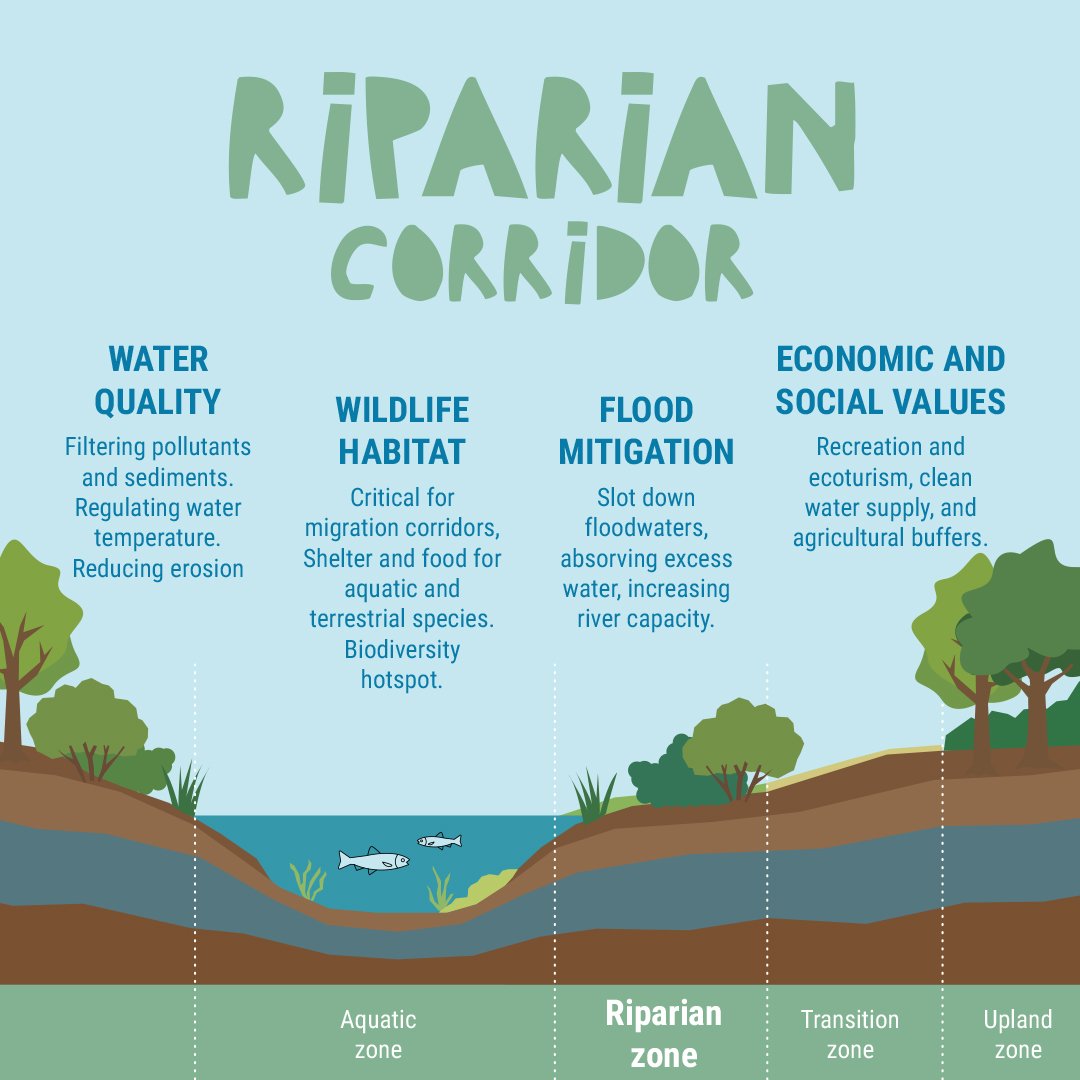
Infographic of riparian corridor including the aquatic zone, the riparian zone, the transition zone and the upland zone.
Great, now the work: deep roots, deep science
Before a single student arrived, there were months of preparation. The STRAW team mapped the corridor, assessed fencing, and assembled detailed planting proposals, species lists, density plans, and anticipated locations for each plant, all marked ahead of time with hundreds of little colored flags (pink, yellow, white) dotting the field like a garden drawn in anticipation.
The team decided to widen the protected corridor beyond the existing fence lines, creating more space for the habitat to develop. Professional crews from the North Bay Conservation Corps cleared years of invasive blackberry, thorny, aggressive, and closest to Petaluma road, before the planting could begin. Then, last November, STRAW started dropping in the first willows, grown from cuttings taken nearby and planted so they could take hold before the student groups arrived.
When it was time to plant the broader mix, STRAW brought something most restoration projects overlook: native soil. On an earlier visit, the team hiked into the surrounding hills to collect acorns from local oaks, and scooped soil from the based of the same trees, rich with native mycorrhizal fungi that have a symbiotic relationship with the oaks. Years of experience had taught them that planting a nursery-grown tree without this fungal community is a gamble. Roots that grew in a pot can struggle to adapt to native ground. A tree might survive five years and then quietly wither. With the right soil, the odds change significantly.
“It’s hard science coming together with local ecology. They think about native soil and that’s a gamer changer”
In the end, over 50 native species were planted - trees, shrubs, and flowering plants - each protected by an exclusion cage to keep deer at bay while the roots establish. When it all grows in, this won’t be a simple willow corridor. It will be a layered, complex riparian habitat unlilke most of what you find in Marin County today.
What 400 students brought
Over three months, groups ranging from 20 to 85 students arrived at the farm, elementary to high school age, from schools across the region. Some came from West Marin, kids who grew up with garden beds at school and weekend hikes with their parents. Others came from the Canal district in San Rafael, one of the area’s most underserved communities, many of whom had never been out to West Marin before. The final group included students who were hard of hearing, with sign language interpreters and microphones making sure no one was left out of the experience.
What all of them had in common was the same thing: enthusiasm. Genuine, unstoppable, enthusiasm.
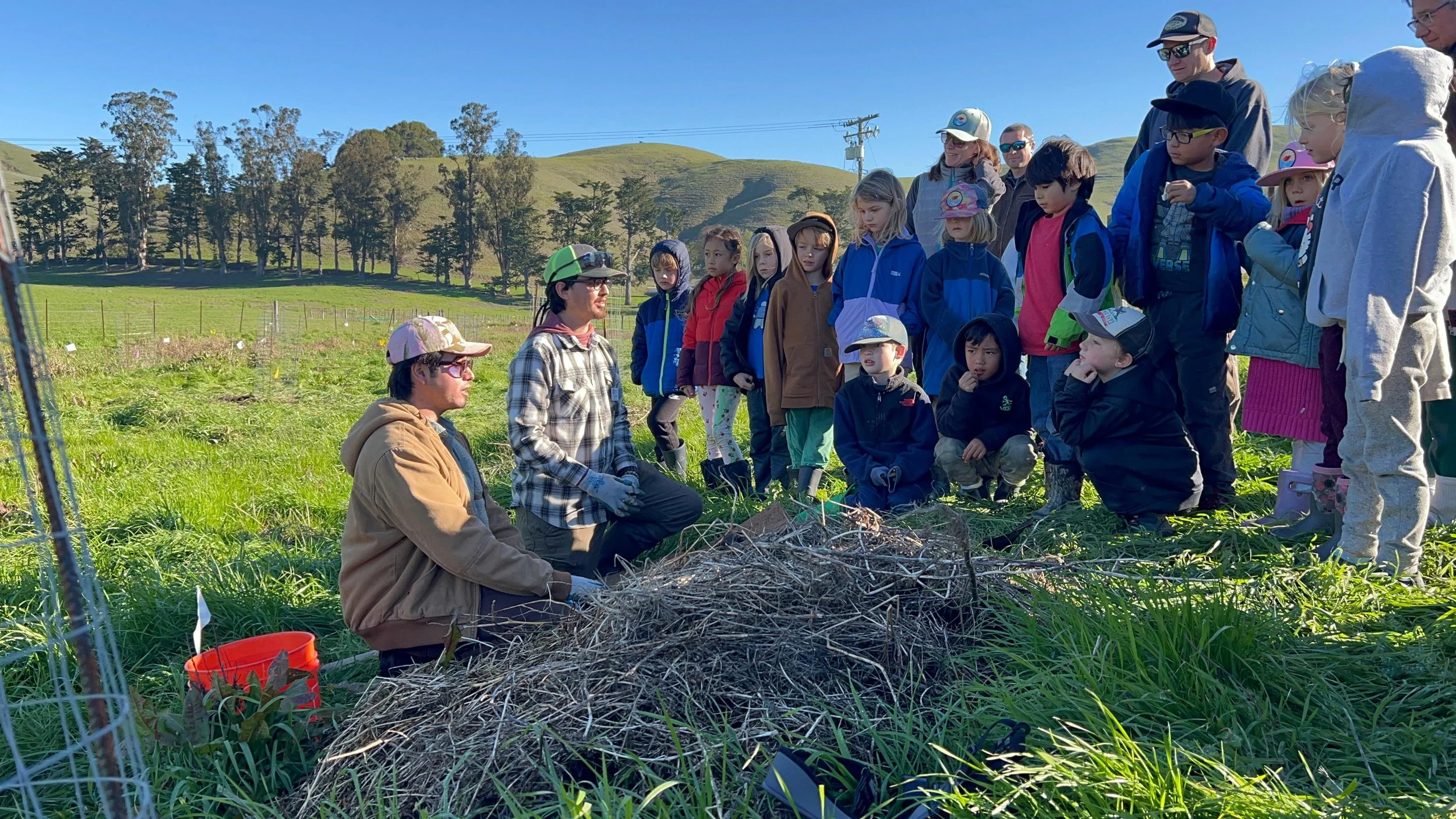
STRAW volunteers explaining riparian corridors to the students attending the visit.
“Kids from San Jeronimo Valley were so carefully taking care of the worms they found as they were digging, holding them in their hands, laughing, having fun, connected with sensitive participants. That’s what it’s all about.”
STRAW didn’t just drop students into the field unprepared. Every group had been learning about riparian zones in the classroom before they arrived, how water moves from highland areas through creek corridors and all the way to the ocean, why watersheds matter, and what restoration actually does. The farm visit was the final act of a full educational arc, not a field trip in isolation.
“It’s like humans love this stuff”, Matt reflected. “It’s like, yeah, we’re part of this thing that’s so much bigger, bigger than our concrete and our brand names, and our cars. It’s kind of remembering.”
Conservation and food production are the same thing
At Blue Marble Acres, watershed restoration was never conceived as a side project. It is the project, inseparable from how we think about farming. California doesn’t have a water shortage problem. It has a water storage problem. In winter, rivers bring extraordinary amounts of rain. The question is whether the land can hold it, and whether it moves slowly enough through the landscape to recharge the creeks, the aquifers, and the soil that farms and communities depend on through the dry months. Every restored riparian corridor, every deep-rooted native planting, every pond converted from an old manure lagoon is part of an answer to that question.
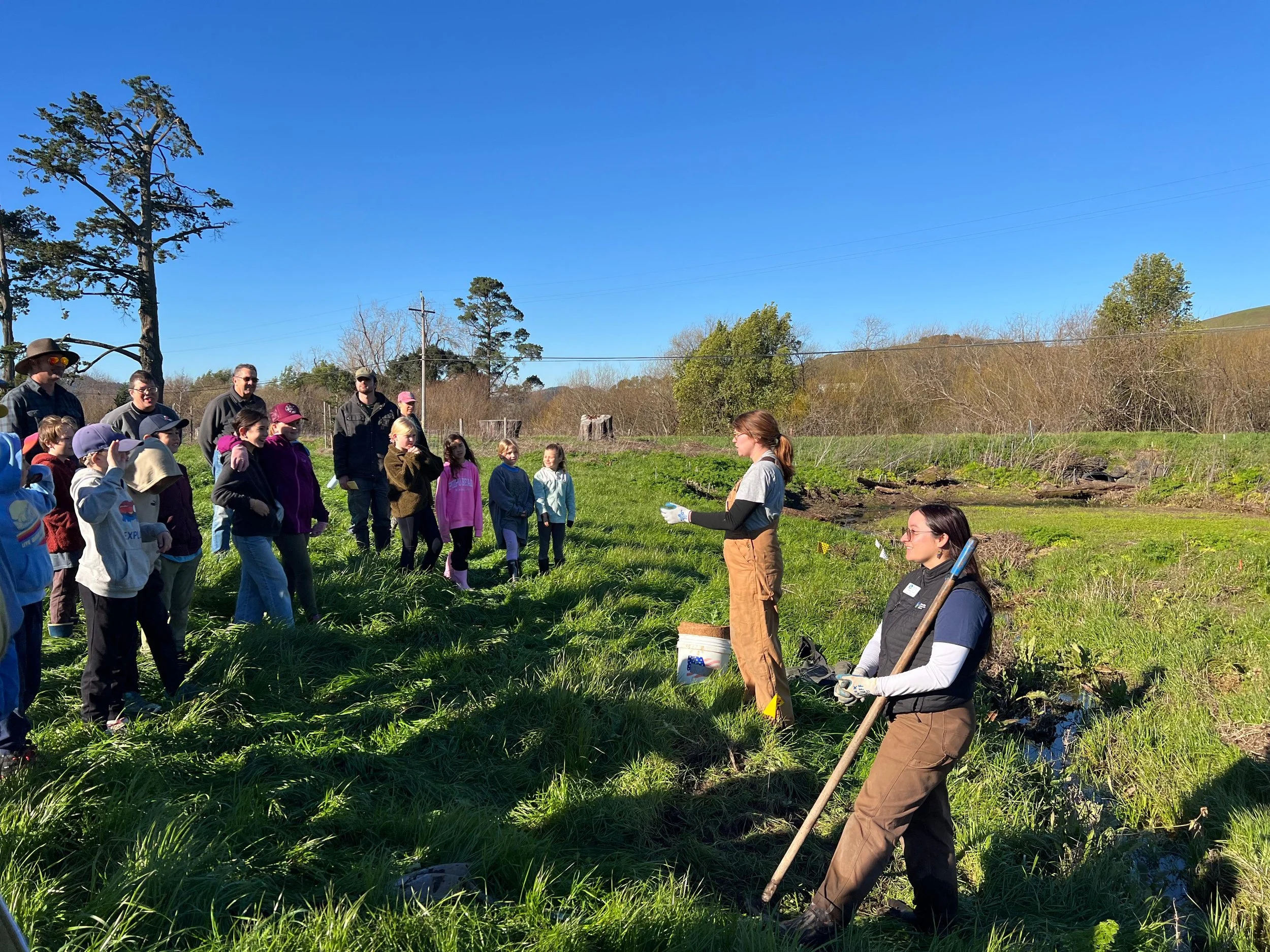
Another STRAW volunteers working with another group of students during the visit.
“Whatever we are doing to the land that is helping it improve, that is helping local biological communities, that is helping our watershed, that is the thing that is going to make our food better.”
The riparian corridor is one piece of a larger vision. The team is already looking at the next phase of work: adding riparian lines on a second parcel that connects to marshland along Nevada Boulevard, and planting deep-rooted native grasses that can hold water in the hills long after the rains stop. The goal, corridor by corridor and season by season, is a landscape that takes care of itself and takes care of everyone who depends on it.
Short clip of Matt explaining some of the intergenerational impact of STRAW’s partnership to Daniel for this article.
What comes next and how to join
The corridor is fenced off for five years while the plantings establish, a quiet protected stretch that wildlife can move trhough freely while the roots go deep. STRAW will continue to water each plant by hand throughout the dry season, about two gallons per plant per week, because they’ve learned over 34 years that this human touch, someone actually our there, tending, makes the difference between a restoration that holds and one that doesn’t.
We’ve submitted our application for next year’s STRAW cycle and hope to continue expanding the work. And if you want to be part of what’s growing here, whether as a school, a teacher, or someone looking to grow your own food on land that’s being brought back to life, we’d love to hear from you!
As Matt putt it at the end of our conversation: “It’s a privilege to do this work. And it’s just the beginning of a really powerful, transformative project”.
Get involved
To bring STRAW’s watershed restoration curriculum to your school, visit Point Blue website. To lease land at Blue Marble Acres, and grow your own food as part of our regenerative farming community, visit our Farmer’s Program. If you like this content and want to support our farm please share this article.

Visit Point Blue website and donate to their STRAW program
