

How Blue Marble’s mushroom lab was built from scratch
Some of the best projects at Blue Marble Acres start small, a side hobby during the slow season that turns into something the whole ranch relies on. That’s exactly how our mushroom lab came to be. I sat down with Edgar, our Agricultural Manager, to talk about his passion for mushroom cultivation, what actually happens inside the lab, and why he thinks mushrooms might be one of the most underrated organisms on the planet.
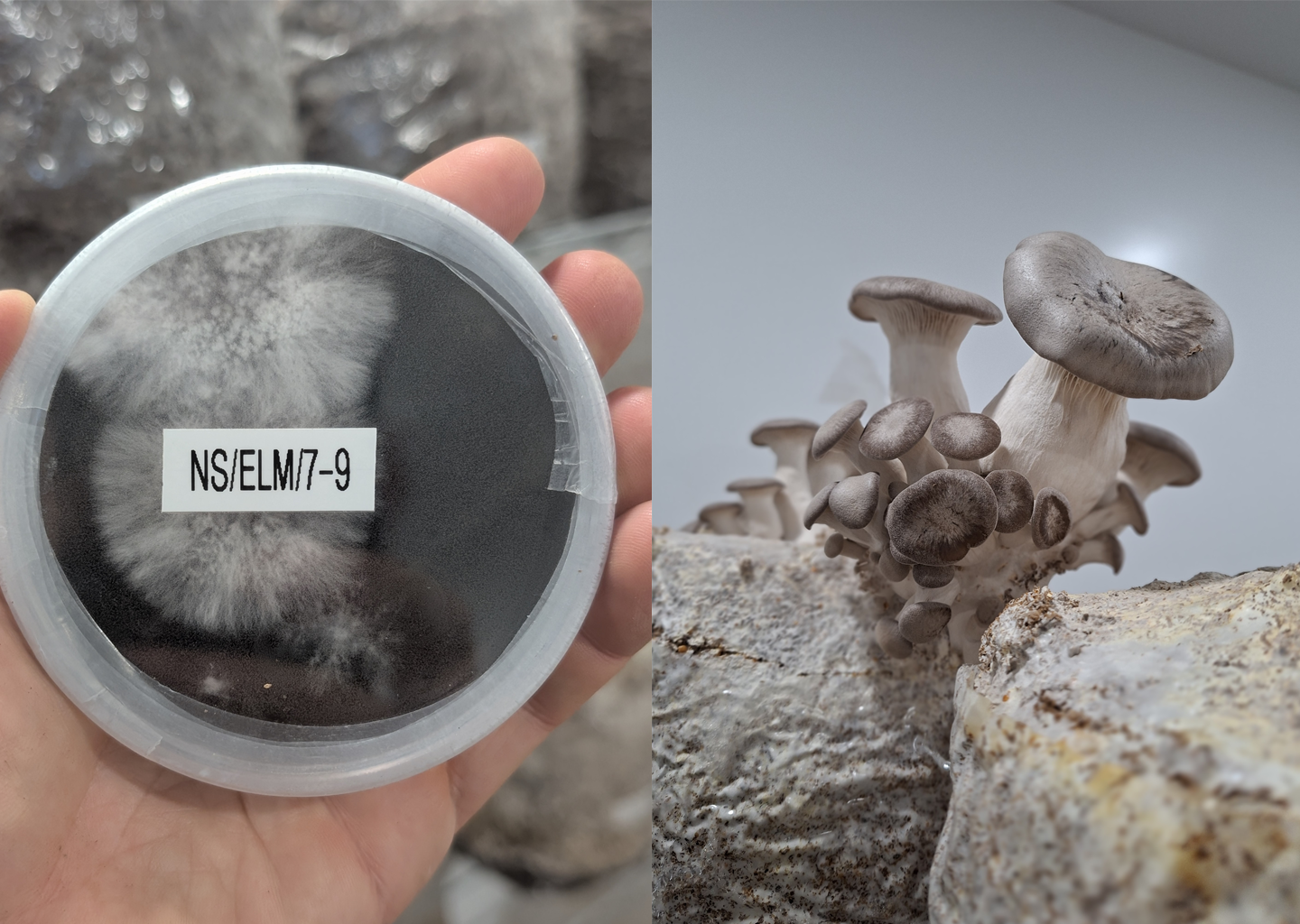
LEFT: Petri dish with Nest Elm Oyster mushroom lab culture sample. RIGHT: a Blue Oyster mushroom fruiting block.
From a wine lab to a mushroom lab
Edgar’s path into mushrooms was not random. Before Blue Marble, he spent years making wine, which meant spending a lot of time in a lab, running tests, managing sanitation, and keeping everything sterile. It turns out that skill set transfers almost perfectly to growing mushrooms.
“Any kind of bacteria or fungi can take over,” Edgar explained. “So the way that you do it, and how sterile you are and your standard operating procedures, that’s going to determine how successful you are going to end up being.”
Mushrooms started as a wintertime side project, back when the farm slowed down, and there wasn’t much else growing. Edgar began with the most basic setup imaginable: big metal canners inside one of the structures on the property, a bit of trial and error, and a lot of research pulled from mycologist forums, Reddit threads, and YouTube. The hardest part wasn’t the science itself, but sorting through all the conflicting advice online and figuring out, through practice, what actually worked.
The real spark, though, came from something closer to home. Edgar’s daughter became a vegetarian a couple of years ago, and he started looking for affordable ways to get more protein into her diet. Growing mushrooms himself was one answer. He built his first growing setup right in the same room that today’s is our office: a simple fabric grow tent with a couple of fans rigged into the wall, nothing like the space it is today. What amazed him most was the speed: after years of farming, where you wait 60 to 90 days to see a harvest, his first mushrooms went from pinning to picking in just three or four days.
That first system also connected him to another person at the farm in an unexpected way. When I recently talked to Rodolfo, Blue Marble’s construction lead, about which project he was most proud of, Rodolfo pointed straight to the new mushroom lab, one of the few structures on the ranch that went from start to finish without turning into an ongoing project. Edgar was touched by that and quick to point out that it was a true collaboration: Edgar brought the mushroom knowledge, and Rodolfo brought the infrastructure skills to actually make the space work.
A walk through the lab
Today, the mushroom operation is split into two rooms, each with its own job.
One room handles sanitation and lab work. At the center of it is a 150-liter vertical sterilizer, a major upgrade from the days of pressure-canning by hand and hoping nothing exploded. There is also a laminar flow hood, which constantly pushes filtered, sterile air across the workspace so nothing drops onto the Petri dishes, grain spawn, or liquid spore syringes Edgar works with.
The second room is where the actual growing happens, and it is split into two stages. First comes the colonization space, where inoculated blocks sit for about two weeks while a web of mycelium, the root-like network of fungus, spreads through the entire block. Edgar has learned to judge when a block is ready to move on almost by feel and sound: a light thumb tells him whether it is fully colonized or still needs time.
Once ready, blocks move to the fruiting room, kept at a slightly cooler 65 degrees with humidity between 80 and 83 percent, misted by a fine fogger that produces droplets small enough for the mushroom to actually absorb. Everything in these rooms- temperature, humidity, airflow, and light is deliberately controlled, and much of it is monitored through an app that alerts Edgar if anything drifts out of range.
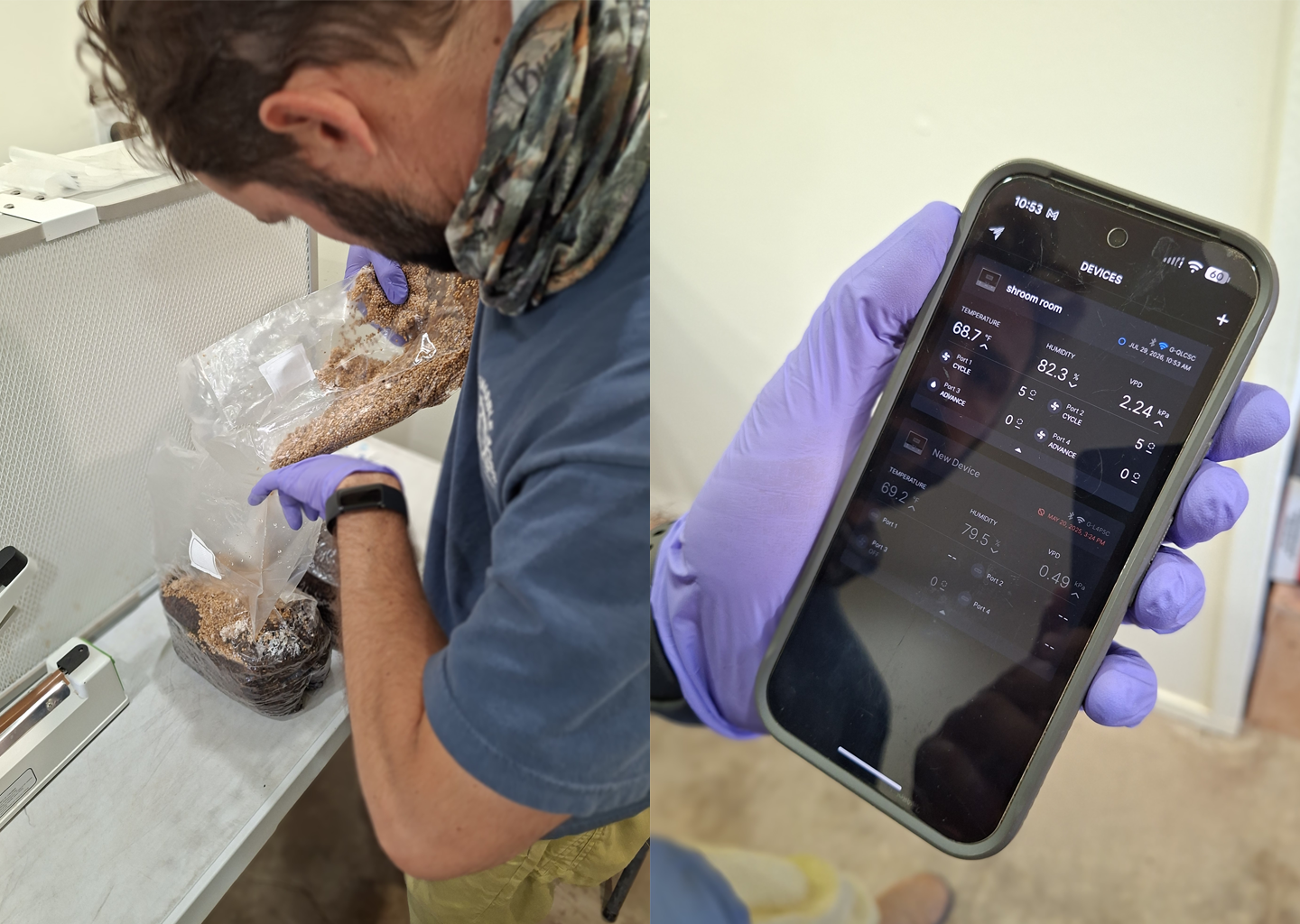
LEFT: Edgar transferring substrate to a cultivation bag. RIGHT: An environmental monitoring app to control temperature, humidity, and VPD (Vapor Pressure Deficit).
The light itself is one of the more surprising details. Mushrooms don’t photosynthesize, so the light is not feeding them; it is telling them which direction to grow, the same way they’d grow toward the sun on a tree trunk in the wild. Fresh air exchange matters just as much: mushrooms actually produce carbon dioxide as they grow, the opposite of a plant, so the fruiting room needs fresh air pumped in from the top while a fan pulls the CO2 out from the bottom. It’s a detail easy to overlook, but get it wrong, and a room full of healthy blocks can stall out fast.
Even the growing medium is chosen with intention. Edgar starts with a grain spawn made from organic millet, prized for how many tiny inoculation points it creates once mixed into a bag. From there, most blocks grow on what is known as a master's mix, a combination of 50% oak sawdust and 50% soybean hulls, both waste products repurposed into something productive. It is a small but meaningful example of the kind of circular thinking that runs through a lot of what happens on the ranch.
Cleanliness, patience, and a bit of pride
Ask Edgar what’s hardest about growing mushrooms, and the answer comes fast: staying clean. A single contamination can spread through an entire batch quickly, and there is a particularly stubborn green mold called Trichoderma that Edgar has learned to watch for constantly. Keeping the racks, walls, and tools sanitized, sometimes with diluted alcohol, sometimes with a light bleach solution for a deep clean, is a never-ending part of the job.
Despite the challenges, what Edgar is most proud of is not a single harvest or a fancy piece of equipment. It is the process of genuinely learning the craft from the ground up.
““I always take pride in the fact that I do go all the way in, and that I figure something out, so it feels good to be like, oh well, I have some knowledge about it.””
He is also candid about one of the biggest misconceptions people have about mushrooms. I did mention to him my own experience in Costa Rica, where many people grew up only knowing the mushroom found on pizza, and a common myth is that eating the wrong mushroom will automatically get you sick. In reality, that risk applies to a very small slice of all mushroom varieties. Much of the disconnect, Edgar believes, comes down to exposure; the mushrooms that make it to the grocery stores are usually chosen for shelf life and ease of shipping, not flavor or variety, which means most people never get the chance to try anything beyond the basics.
Flavor, texture, and a few favorites
Edgar clearly loves cooking as much as he loves growing. He cultivated pink oyster mushrooms that taste like bacon when cooked with smoked paprika, golden oyster mushrooms, more common in tropical Asian climates, and lion’s mane, which he sears in a cast iron pan, marinates, and serves like a thick, dense steak. He is also a fan of reishi, which reminds him of the coral reefs he grew up around in Florida, and a hybrid variety called the Black Pearl King, part King Trumpet, part oyster mushroom, with a texture unlike anything else in the lab.
“The deeper you get into it, the more you are like, oh my God, they are just like superheroes,” Edgar said about mushrooms in general. “I think that’s the coolest thing about them, how many different purposes they serve.”
That range is part of what makes local, small-scale mushroom growing valuable. Many speciality varieties have a very short shelf life, which means they rarely make it into grocery stores far from where they are grown. A hyper-local pipeline, like the one Blue Marble is building, lets people experience mushrooms at their peak, something that simply is not possible when a product has to travel across the country.
What’s growing next
The mushrooms program is scaling up. A new substrate bagger, which doses and fills bags automatically, will cut prep time for a batch from an hour and a half to about fifteen minutes, freeing up a lot of manual labor for other projects.
Edgar is also looking at sustainability upgrades, including biodegradable growing bags to replace standard plastic, and he is especially excited about a variety of mushrooms capable of breaking down polyurethane, a potential tool for composting plastic waste down the line.
When asked what gives him hope on the harder days, Edgar didn’t talk about yields or equipment. He talked about people.
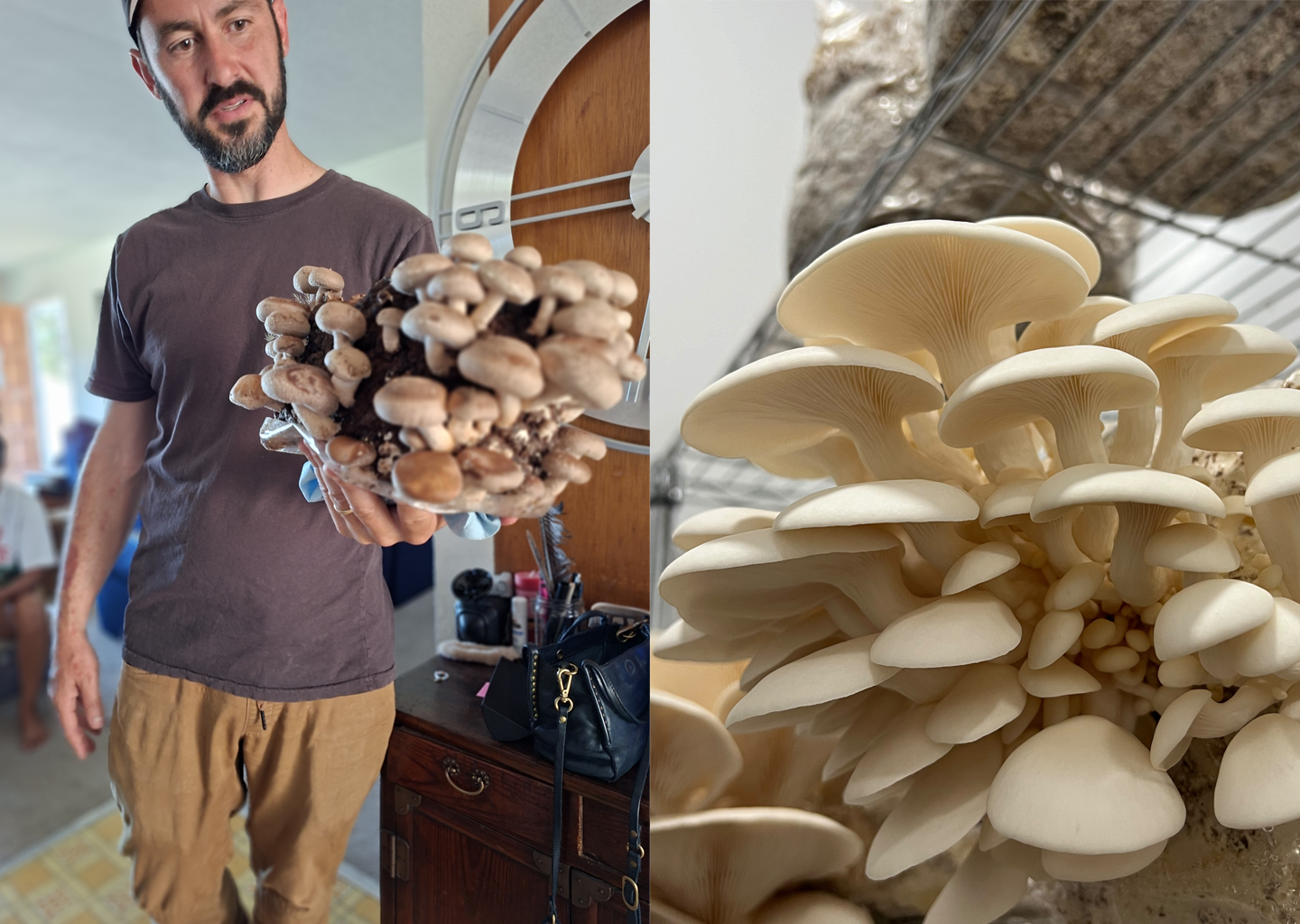
LEFT: Edgar holding a Shiitake mushroom block ready to use. RIGHT: a thriving cluster of White Oyster mushroom.
“Any movement that is worthwhile in the history of the world is always grassroots,” he said.
“I think a lot of the future is agrarian, growing food, cooking; this has always been at the center of what we as people are engaged in. Seeing people willing to get back in touch with their humanity, that is inspiring on its own.”
It is a fitting way to think about the mushroom lab itself: a small, curious project that started with a father wanting better protein options for his daughter, and grew, quite literally, into something the whole ranch now shares in.
Next time you are at Blue Marble Acres, ask about what’s fruiting in the lab. Chances are, Edgar has already found a new way to cook it.
